

At ModnPods, every project starts long before the first module arrives on site.
It starts with the ground.
As we prepare for our largest project to date at North Stradbroke Island, the focus is on getting the fundamentals right — from day one.
That’s where our partnership with Blade Pile comes in.
Modular construction relies on precision, coordination and speed.
That only works when the foundation system aligns with the methodology.
Traditional concrete footings can introduce delays, variability and site disruption.
Engineered screw piles offer a different approach:
Blade Pile’s system is designed to integrate seamlessly with modular delivery.
According to their engineered foundations system:
For projects like North Stradbroke Island, this means:
✔ Reduced programme risk
✔ Faster mobilisation
✔ Predictable installation timelines
We will be installing around 700 screw piles for this specific project.
Blade Pile brings significant experience across Australia:
Their track record spans:
This depth of experience aligns directly with the scale and ambition of our upcoming projects.
At ModnPods, we focus on systems that improve how we build:
Working with Blade Pile allows us to extend that thinking below ground.
Because in modular construction, quality doesn’t start on site —
it starts with the system.
North Stradbroke Island marks the beginning of a new phase for ModnPods.
As we scale our projects, partnerships like this ensure we can deliver with certainty — from the ground up.
Want to know more about this project? Follow us on LinkedIn for more updates as we progress!
Great modular buildings begin with the materials that make them possible.
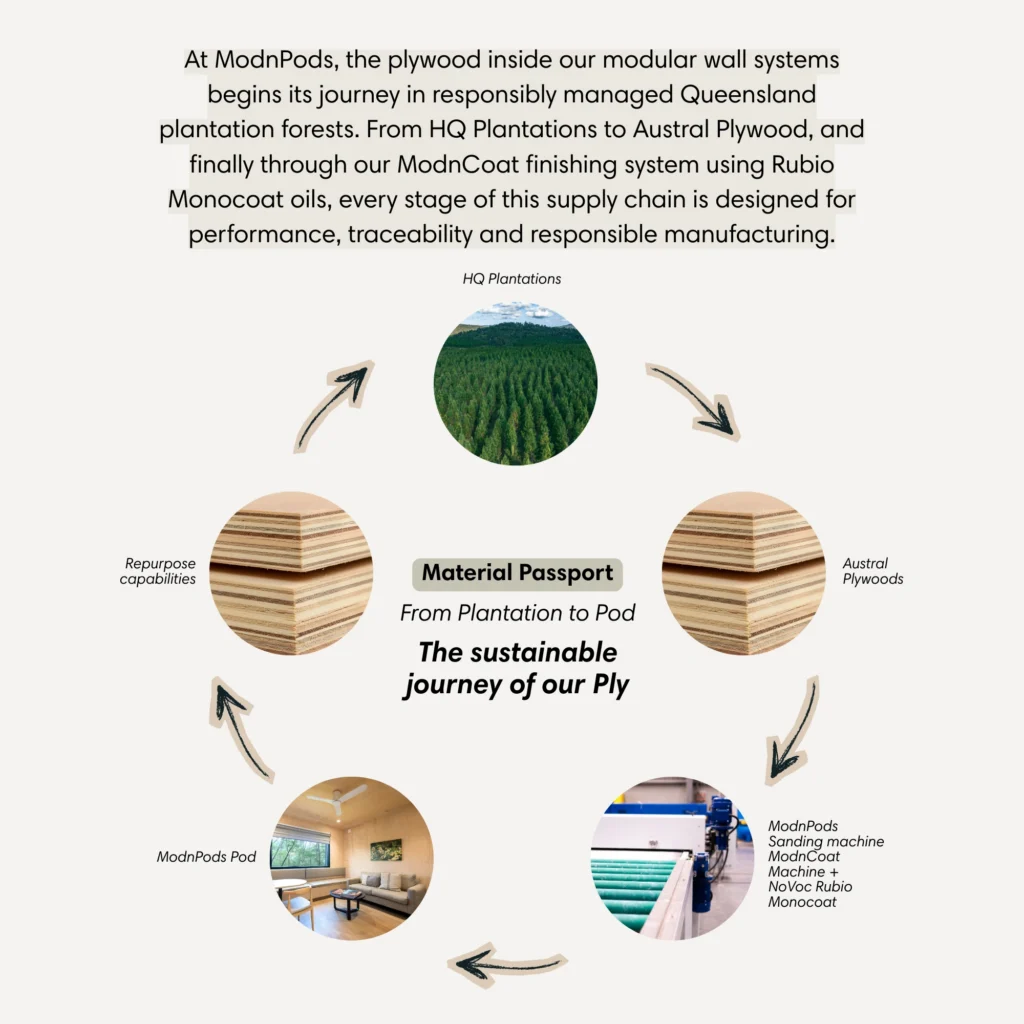
At ModnPods, every wall lining installed inside our modular buildings starts its journey decades earlier in responsibly managed Queensland plantation forests. From plantation-grown Hoop Pine, to Australian plywood manufacturing, to our automated ModnCoat finishing process, each stage of this supply chain plays a role in delivering consistent quality, durability and architectural finish.
This is not just about sourcing plywood.
It is about understanding the full lifecycle of the material — from forest to factory — and ensuring every step aligns with responsible forestry, Australian manufacturing, and lean modular production.
Through partnerships with HQ Plantations, Austral Plywoods and Rubio Monocoat, we are able to manufacture modular interiors that combine structural performance, design flexibility and healthier indoor environments.
From plantation to pod, the story of our plywood reflects the same principle that guides everything we build: quality begins at the source.
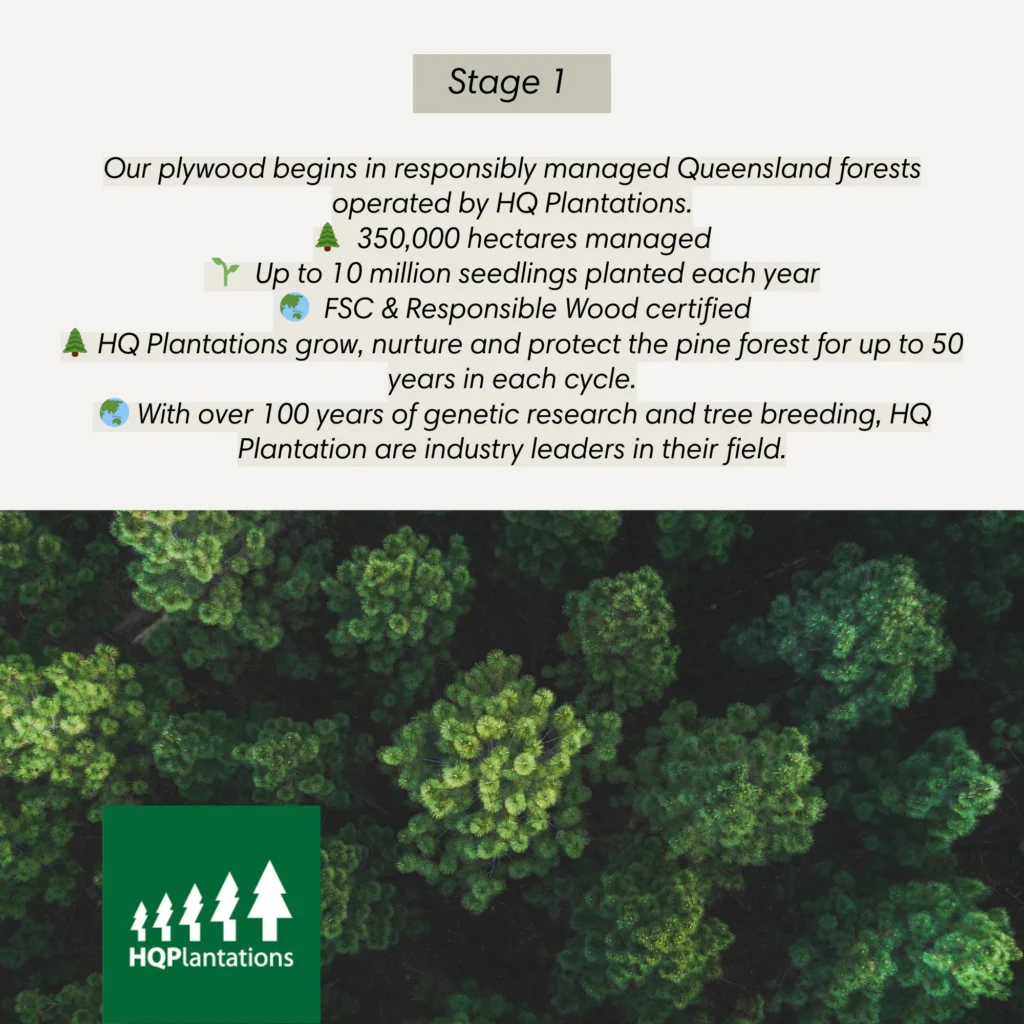
Long before plywood reaches our factory, the process begins in responsibly managed plantation forests across Queensland.
HQ Plantations manages more than 300,000 hectares of plantation forests, growing species such as Araucaria (Hoop Pine) specifically suited to structural and architectural timber products.
Unlike traditional forestry, plantation forestry operates on a continuous cycle of renewal. Up to 10 million seedlings are planted each year, while only 2–3% of plantation areas are harvested annually. Trees are carefully grown for decades — Araucaria typically between 40 and 50 years — before reaching maturity for harvesting.
These forests are independently certified under internationally recognised forestry standards including:
• Responsible Wood Sustainable Forest Management
• Forest Stewardship Council (FSC)
These certifications ensure forests are managed responsibly across environmental, economic and cultural considerations while maintaining long-term resource sustainability.
At the plantation level, responsible forestry ensures the future of timber construction.
Once harvested, the Hoop Pine is processed by Austral Plywoods, an Australian manufacturer with nearly a century of experience in plywood production.
Established in 1925 in Brisbane, Austral Plywoods has played a role in some of Australia’s most recognised architectural and civic projects, including the Sydney Olympic Dome, Perth Arena and the Melbourne Recital Centre.
The company specialises in appearance-grade Hoop Pine plywood known for its:
• straight grain structure
• strength-to-weight performance
• smooth architectural finish
• excellent acoustic properties
Austral Plywoods operates under Chain of Custody certification (AS 4707:2021), meaning every sheet of plywood can be traced from certified forests through to finished product.
For modular manufacturing, this traceability matters.
Material consistency directly influences production efficiency, installation accuracy and long-term performance.
Once plywood sheets arrive at our facility, they are prepared specifically for modular construction.
Unlike traditional building sites where materials are cut and finished on site, modular manufacturing relies on controlled factory processes that prioritise precision, repeatability and minimal waste.
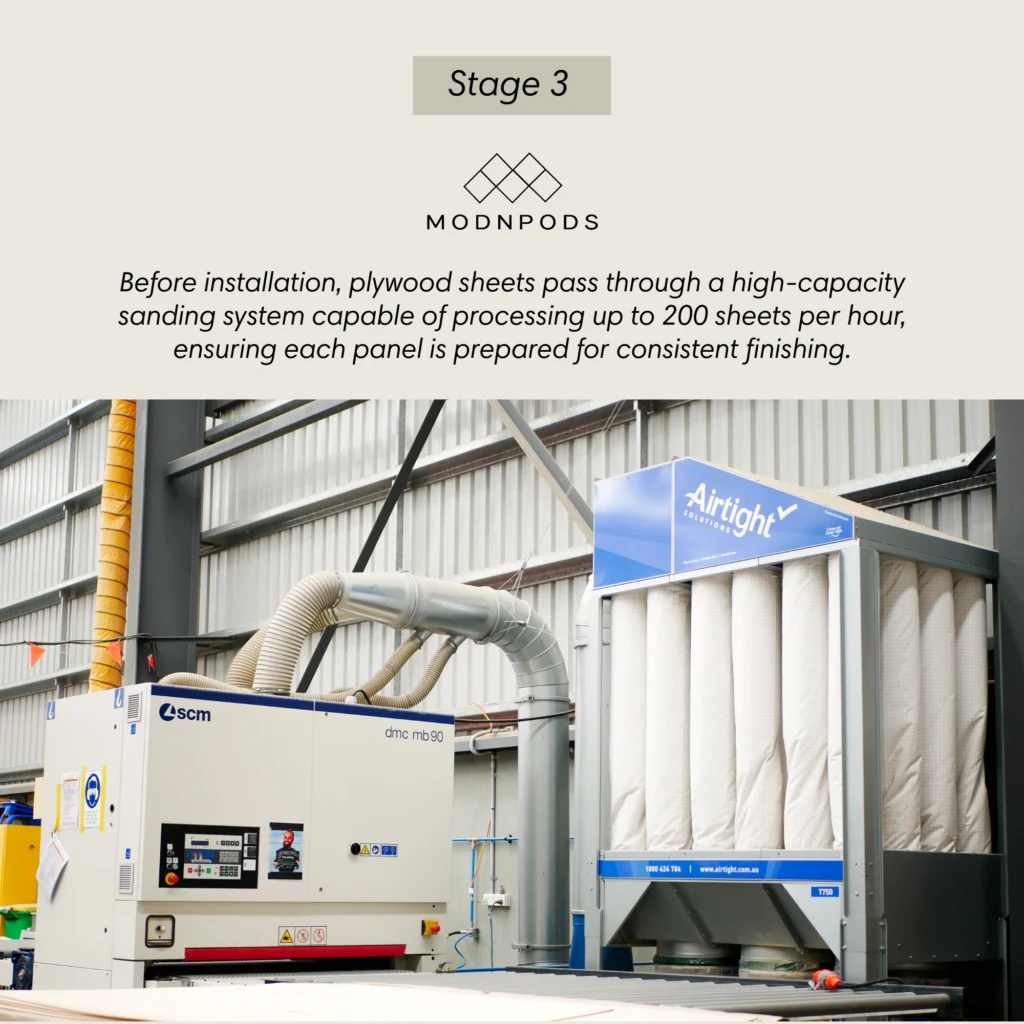
Before installation, plywood sheets pass through a high-capacity sanding system capable of processing up to 200 sheets per hour, ensuring each panel is prepared for consistent finishing.
This preparation stage allows us to integrate interior wall linings directly into our manufacturing workflow.
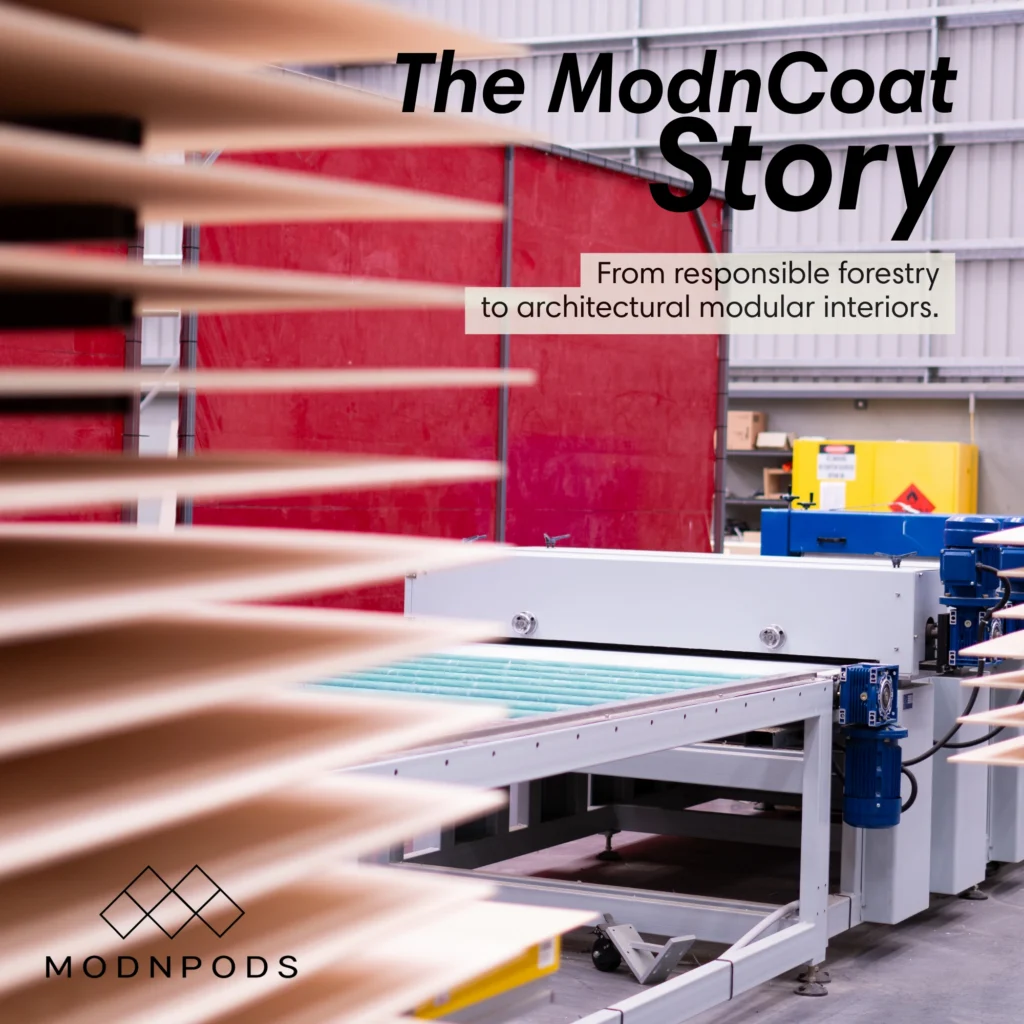
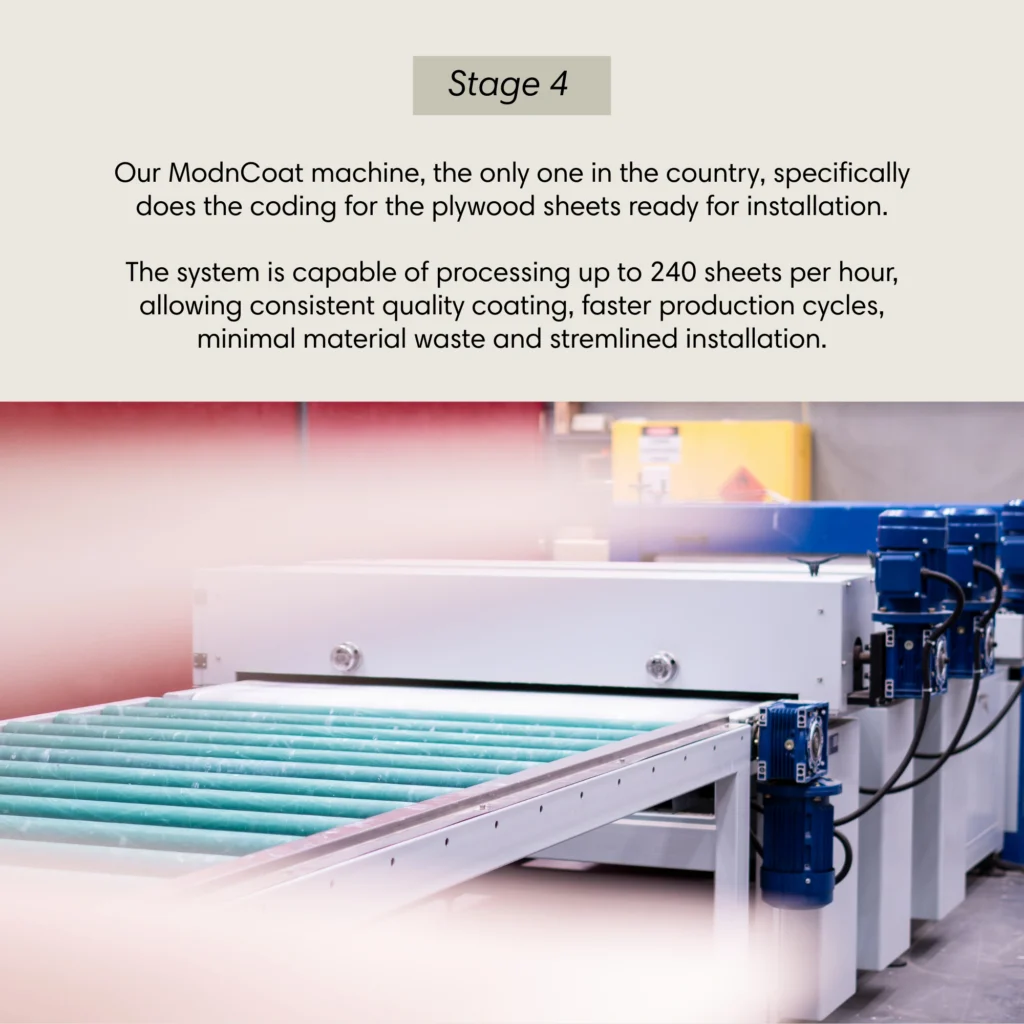
One of the core innovations inside our manufacturing process is the ModnCoat machine, a purpose-built automated system developed specifically for coating interior plywood wall linings.
The system is capable of processing up to 240 sheets per hour, allowing consistent finishing across large production volumes while eliminating the need for traditional interior painting.
This approach delivers several advantages:
• consistent coating quality
• faster production cycles
• reduced site finishing work
• minimal material waste
• streamlined installation within modular assemblies
By integrating finishing directly into the manufacturing process, ModnCoat supports lean production principles while improving final product consistency.
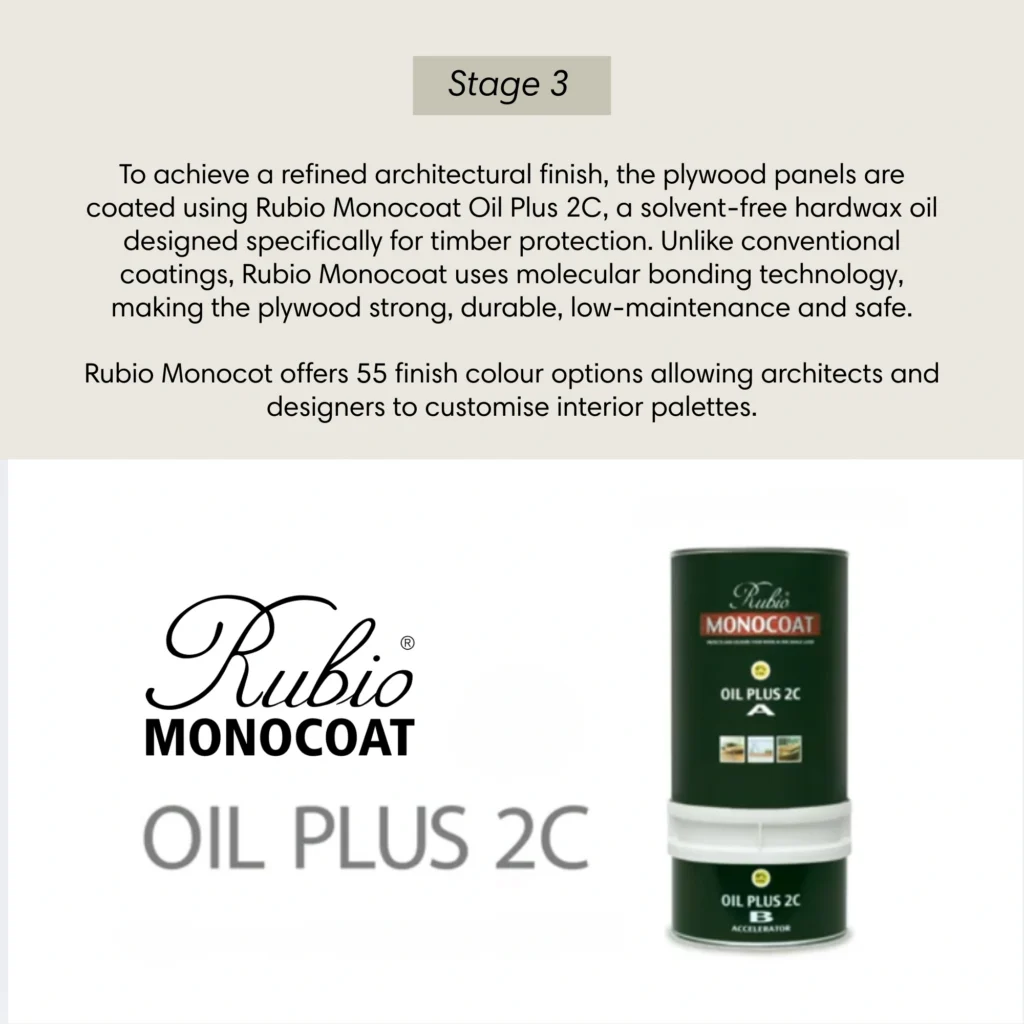
To achieve a refined architectural finish, the plywood panels are coated using Rubio Monocoat Oil Plus 2C, a solvent-free hardwax oil designed specifically for timber protection.
Unlike conventional coatings, Rubio Monocoat uses molecular bonding technology that forms a strong bond with the lignin and cellulose within the timber surface.
This technology offers several advantages:
• 0% VOC content
• Red List Free certification
• durable single-layer application
• natural timber appearance
• water and heat resistance
With more than 55 colour options available, the finish allows architects and designers to customise interior palettes while maintaining consistent quality across projects.
The result is a durable, low-maintenance interior surface with a natural timber aesthetic and healthier indoor air quality.
Plywood plays an important structural role in modular buildings.
Unlike plasterboard, plywood contributes to the structural behaviour of wall assemblies, providing diaphragm strength that improves overall rigidity during transportation and installation.
This is particularly important for modular buildings that are manufactured off-site and transported to their final location.
Benefits include:
• Improved structural stability during transport
• Resistance to cracking and impact
• Faster installation
• Architectural interior finish
• Reduced site finishing work
For modular construction, plywood is both a structural and aesthetic material.
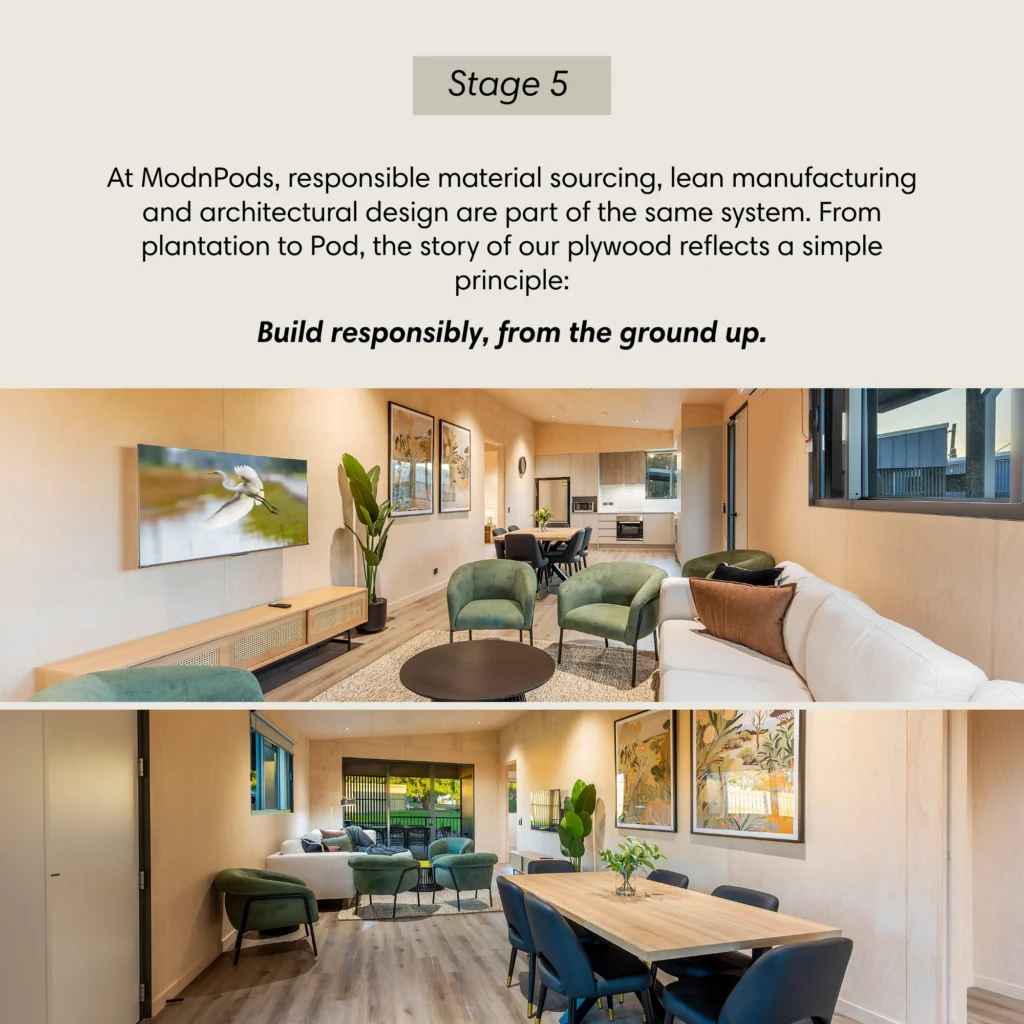
At ModnPods, responsible material sourcing, lean manufacturing and architectural design are not separate ideas — they are part of the same system.
From plantation to pod, the story of our plywood reflects a simple principle:
Build responsibly, from the ground up.
Excited about our ModnCoat machine? Check more information here
Industry frameworks are often talked about, but not always clearly defined. MMC is one of those terms. In this article, we’ll explore what Modern Methods of Construction mean to ModnPods — and how we apply it across design, manufacturing and installation. Before we do, it’s worth clarifying what MMC actually refers to. Modern Methods of Construction (MMC) describes a suite of construction approaches that move critical building activities away from traditional site-based delivery and into controlled, repeatable environments.
At ModnPods, MMC is the foundation of how we design, manufacture, transport and install buildings across Australia. Our approach combines off-site manufacturing, digital design coordination, lean production systems and precision installation to deliver buildings that are faster to deploy, cost-predictable and built for long-term performance.
MMC is often misunderstood as “temporary”, “transportable” or “lightweight”. In reality, MMC encompasses:
Volumetric modular construction
Panelised and component-based prefabrication
Hybrid construction models combining off-site and on-site works
Digitally led design-for-manufacture-and-assembly (DfMA)
ModnPods applies MMC through fully enclosed volumetric modular buildings, manufactured under controlled factory conditions in our 6,300m² Gold Coast facility, then installed on site using engineered foundations and precision cranage.
MMC starts at concept stage. Our in-house design and engineering teams work through a staged, gated design process that embeds:
Site constraints and transport limits
Modular repeatability and scalability
Safety in Design (SiD) from concept to IFC
NCC, DDA and performance compliance verification at every stage
This ensures designs are not just compliant — they are buildable, repeatable and installation-ready before manufacturing begins.
"At ModnPods, Design is resolved before construction begins — not during it".
Every ModnPods build is manufactured in our 6,300m² Gold Coast facility using lean manufacturing principles and digitally driven production systems. Factory conditions remove weather risk, reduce rework, and enable consistent quality control that traditional site-based builds struggle to achieve.
This includes:
Heavy-gauge steel chassis engineered for transport, stacking and long-term durability
Light-gauge steel framing and integrated wall and roof systems
Automated roll-forming directly from BIM models
Fully completed internal fit-outs prior to delivery
MMC on Site: Faster, quieter, more predictable
MMC does not eliminate site works — it reduces complexity; that’s the beauty and grade of modular solutions.
At ModnPods, site works run in parallel with manufacturing and typically include:
Screw pile foundations (preferred where soil conditions allow)
Pre-installed service interfaces
Engineered cranage and placement
Rapid “plug-and-play” connections
MMC supports sustainability through process control, not shortcuts. Our environmental approach includes:
Reduced material waste through factory optimisation
Durable, low-maintenance materials selected for long service life
Energy-efficient building envelopes
Reduced site disturbance and ground impact
Circular economy thinking embedded into materials and supply chains
Sustainability, for ModnPods, is about quality, longevity and performance over the full life of the building.
MMC is not a replacement for traditional construction — it is a collaborative evolution.
ModnPods regularly works with:
Builders delivering site works and services
Architects designing within modular frameworks
Government and institutional clients requiring certainty at scale
Hybrid models allow traditional construction expertise and off-site manufacturing to work together — improving certainty, reducing risk, and accelerating delivery without compromising design intent.
In summary, Modern Methods of Construction enable better outcomes when applied with discipline, experience and transparency. At ModnPods, MMC is proven, scalable, and embedded into how we deliver modular solutions in Australia.
To learn more about our Lean Manufacturing Advantage is, check our ModnWay here.

As a prominent manufacturer of housing solutions in Australia, ModnPods is leading the way in establishing the highest quality standards within the industry. Our unwavering commitment to lean manufacturing has fuelled our drive to become an industry innovator, constantly optimising our products and processes
One of our key strategies involves the implementation of lean manufacturing, a modern production model that enables us to streamline operations, reduce costs, and enhance the overall quality of our final products. Throughout our manufacturing process, it is imperative for us to uphold our promise of sustainability and reduced carbon footprint.
At ModnPods, our team collaborates closely to continually refine the design elements of our modular pods. Our Production Team Leaders maintain open lines of communication with our in-house designers and architects, working together to identify opportunities for waste reduction and efficiency enhancement at every stage of a project.
A recent illustration of this collaborative effort arose when our manufacturing team raised a concern about our finished plywood coating process. It was observed that several coated plywood panels were being concealed with cabinetry that did not require an additional finish. Recognising this as an opportunity to minimise waste and optimise our production time, we took decisive action.
In response, our design team incorporated an additional step into their project drawings and plans. They began indicating which plywood panels required coating before installation and which ones did not. By numbering and mapping out the panels on the project drawings, we empowered our manufacturing team to expedite the finished plywood coating process and eliminate unnecessary product waste.
This initiative has not only conserved valuable resources but has also served as a testament to our continuous evolution and collective dedication to a lean and environmentally conscious production process. By fostering collaboration and embracing innovative solutions, we constantly push the boundaries of what modular manufacturing can achieve.
Another example of environmentally beneficial collaboration also concerns our ply. By continuously working with our supplier and providing a consistent volume of work through our lean manufacturing methods, we were able to negotiate industry non-standard size sheets to better fit our Pods. This resulted in less cuts, less labour and took our ply waste from 28% down to .5%.
Looking ahead, ModnPods remains unwavering in our commitment to integrating environmental practices into our operations, product design, and lean manufacturing processes. We will persistently explore new avenues for improvement and cultivating a culture of innovation within our organisation. Together, we can create a better experience within our modular solutions for our clients.
When it comes to planning a holiday or a weekend getaway, finding the perfect accommodation plays a crucial role in creating memorable experiences. Traditional hotels and resorts have long been the go-to options for travellers, but in recent years, a new trend has been emerging in the Australian tourism industry: the rise of commercial modular accommodation in holiday parks. These innovative and flexible structures are changing the way people experience and enjoy their down time.
Holiday parks have traditionally offered a range of accommodation options, including camping sites, caravans, cabins, and chalets. While these options have their own charm, they often lack the comfort and amenities that many modern travellers seek. Commercial modular cabins are now being introduced into holiday parks as an alternative accommodation solution that combines the benefits of the creature comforts of a home with the advantages of prefabricated construction and off-site manufacturing.
Holiday park owners can now work closely with manufacturers to design cabins that meet their specific needs and cater to their valued guests. Whether it’s creating larger family units, adding extra bedrooms or bathrooms, or incorporating unique features such as private decks or other traditional amenities, modular buildings can be tailored to provide a truly personalised experience.
Manufactured using high-quality materials and adhere to stringent building codes and regulations, our controlled factory environment ensures consistent quality control throughout the entire process. Moreover, modular solutions are often considered more efficient than traditional building methods. The off-site manufacturing reduces material waste, and offers the ability to disassemble and relocate the buildings minimising environmental impact.
Since the modules are manufactured off-site, the time required for on-site construction is minimal. This means that holiday park owners can quickly add or upgrade accommodation Pods to meet the growing demand or respond to seasonal fluctuations, allowing for a faster return on investment.
The rise of modular solutions in holiday parks marks a significant shift in the way we think about accommodation. Our innovative Pods provide a unique accommodation alternative for the ever evolving needs and expectations of modern travellers. As more holiday parks embrace this new way of enjoying the places where we stay, we look forward to supporting the industry with smart modular solutions.
Select your desired option below to share a direct link to this page.
Your friends or family will thank you later.