

At ModnPods, every project starts long before the first module arrives on site.
It starts with the ground.
As we prepare for our largest project to date at North Stradbroke Island, the focus is on getting the fundamentals right — from day one.
That’s where our partnership with Blade Pile comes in.
Modular construction relies on precision, coordination and speed.
That only works when the foundation system aligns with the methodology.
Traditional concrete footings can introduce delays, variability and site disruption.
Engineered screw piles offer a different approach:
Blade Pile’s system is designed to integrate seamlessly with modular delivery.
According to their engineered foundations system:
For projects like North Stradbroke Island, this means:
✔ Reduced programme risk
✔ Faster mobilisation
✔ Predictable installation timelines
We will be installing around 700 screw piles for this specific project.
Blade Pile brings significant experience across Australia:
Their track record spans:
This depth of experience aligns directly with the scale and ambition of our upcoming projects.
At ModnPods, we focus on systems that improve how we build:
Working with Blade Pile allows us to extend that thinking below ground.
Because in modular construction, quality doesn’t start on site —
it starts with the system.
North Stradbroke Island marks the beginning of a new phase for ModnPods.
As we scale our projects, partnerships like this ensure we can deliver with certainty — from the ground up.
Want to know more about this project? Follow us on LinkedIn for more updates as we progress!
Great modular buildings begin with the materials that make them possible.
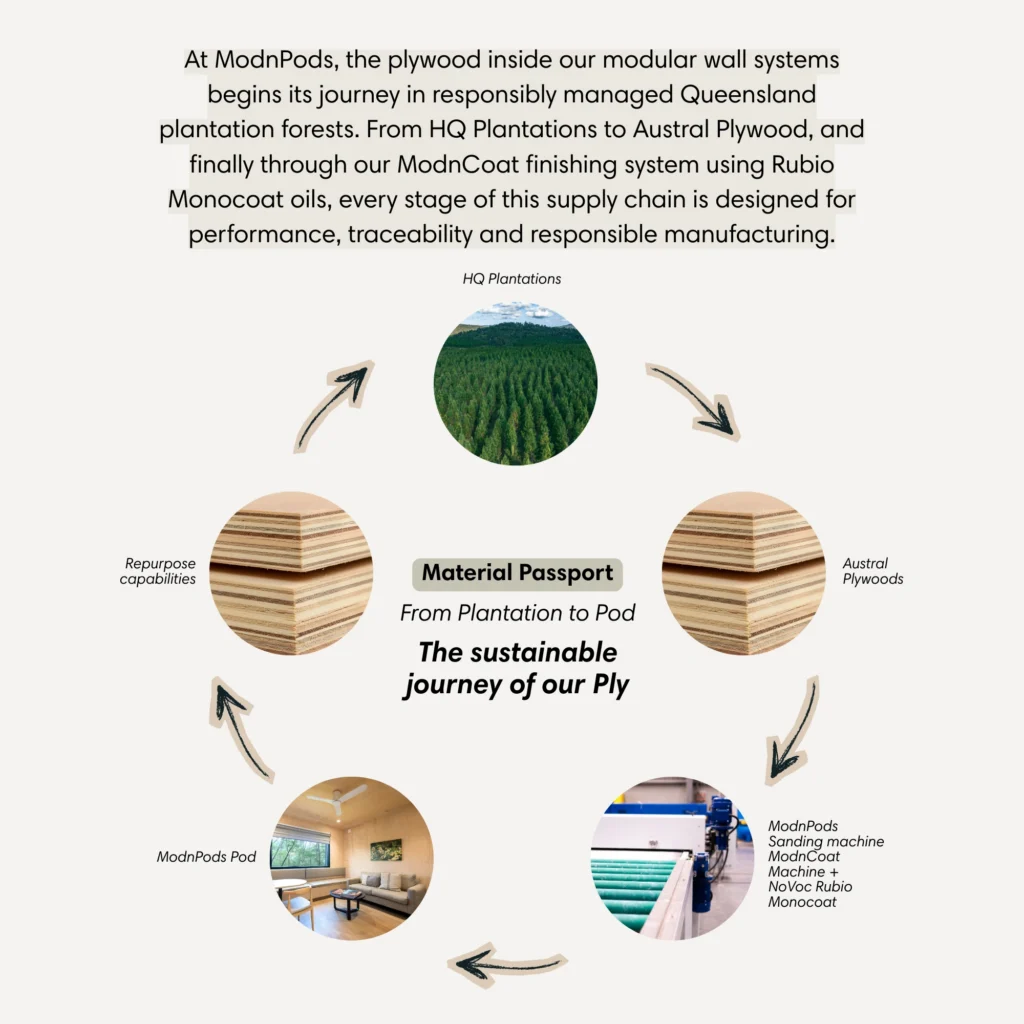
At ModnPods, every wall lining installed inside our modular buildings starts its journey decades earlier in responsibly managed Queensland plantation forests. From plantation-grown Hoop Pine, to Australian plywood manufacturing, to our automated ModnCoat finishing process, each stage of this supply chain plays a role in delivering consistent quality, durability and architectural finish.
This is not just about sourcing plywood.
It is about understanding the full lifecycle of the material — from forest to factory — and ensuring every step aligns with responsible forestry, Australian manufacturing, and lean modular production.
Through partnerships with HQ Plantations, Austral Plywoods and Rubio Monocoat, we are able to manufacture modular interiors that combine structural performance, design flexibility and healthier indoor environments.
From plantation to pod, the story of our plywood reflects the same principle that guides everything we build: quality begins at the source.
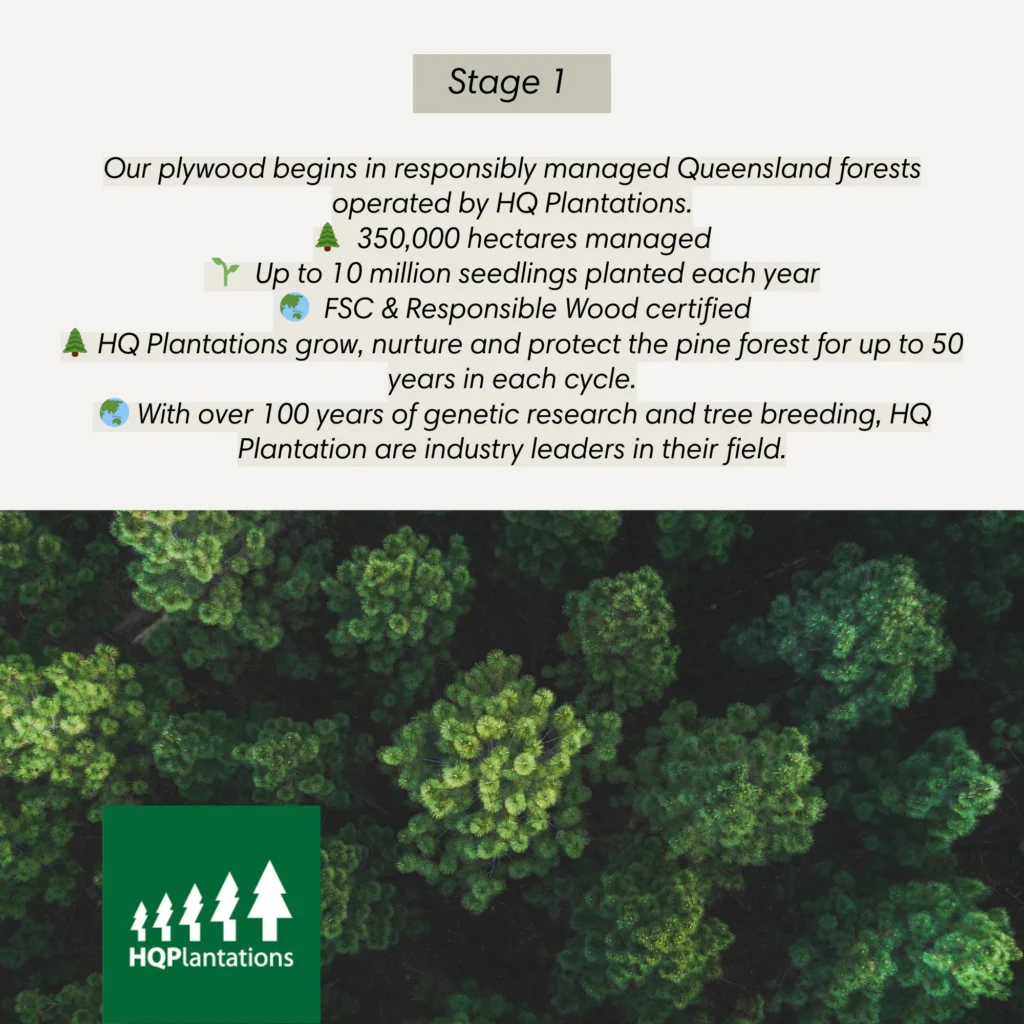
Long before plywood reaches our factory, the process begins in responsibly managed plantation forests across Queensland.
HQ Plantations manages more than 300,000 hectares of plantation forests, growing species such as Araucaria (Hoop Pine) specifically suited to structural and architectural timber products.
Unlike traditional forestry, plantation forestry operates on a continuous cycle of renewal. Up to 10 million seedlings are planted each year, while only 2–3% of plantation areas are harvested annually. Trees are carefully grown for decades — Araucaria typically between 40 and 50 years — before reaching maturity for harvesting.
These forests are independently certified under internationally recognised forestry standards including:
• Responsible Wood Sustainable Forest Management
• Forest Stewardship Council (FSC)
These certifications ensure forests are managed responsibly across environmental, economic and cultural considerations while maintaining long-term resource sustainability.
At the plantation level, responsible forestry ensures the future of timber construction.
Once harvested, the Hoop Pine is processed by Austral Plywoods, an Australian manufacturer with nearly a century of experience in plywood production.
Established in 1925 in Brisbane, Austral Plywoods has played a role in some of Australia’s most recognised architectural and civic projects, including the Sydney Olympic Dome, Perth Arena and the Melbourne Recital Centre.
The company specialises in appearance-grade Hoop Pine plywood known for its:
• straight grain structure
• strength-to-weight performance
• smooth architectural finish
• excellent acoustic properties
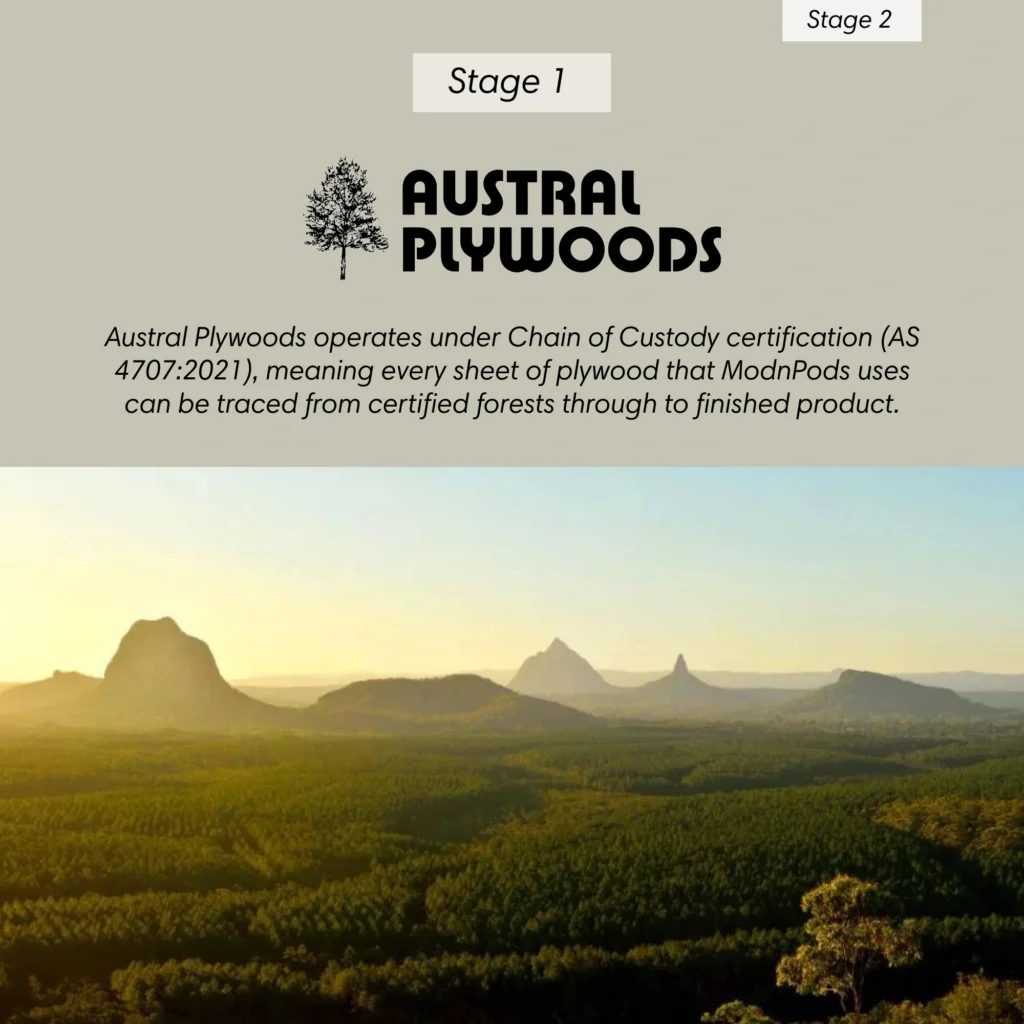
Austral Plywoods operates under Chain of Custody certification (AS 4707:2021), meaning every sheet of plywood can be traced from certified forests through to finished product.
For modular manufacturing, this traceability matters.
Material consistency directly influences production efficiency, installation accuracy and long-term performance.
Once plywood sheets arrive at our facility, they are prepared specifically for modular construction.
Unlike traditional building sites where materials are cut and finished on site, modular manufacturing relies on controlled factory processes that prioritise precision, repeatability and minimal waste.
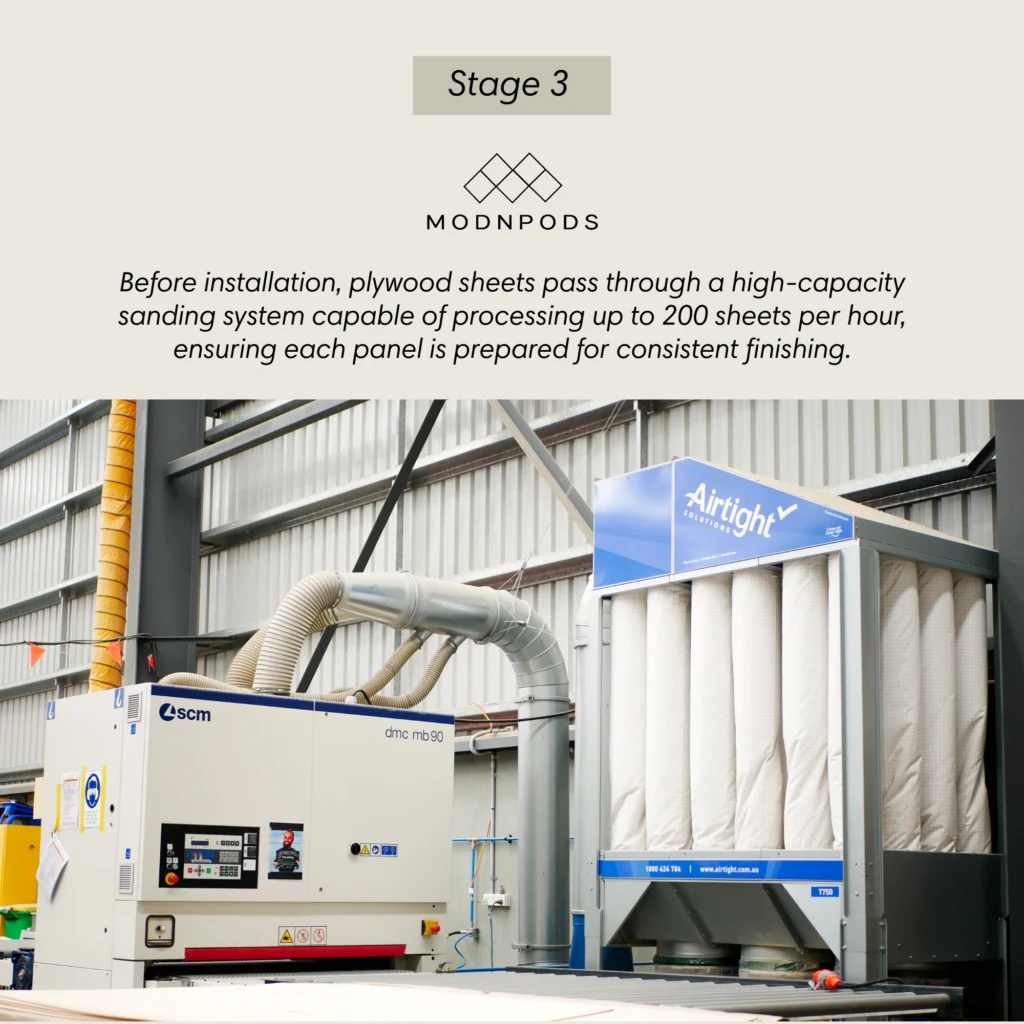
Before installation, plywood sheets pass through a high-capacity sanding system capable of processing up to 200 sheets per hour, ensuring each panel is prepared for consistent finishing.
This preparation stage allows us to integrate interior wall linings directly into our manufacturing workflow.
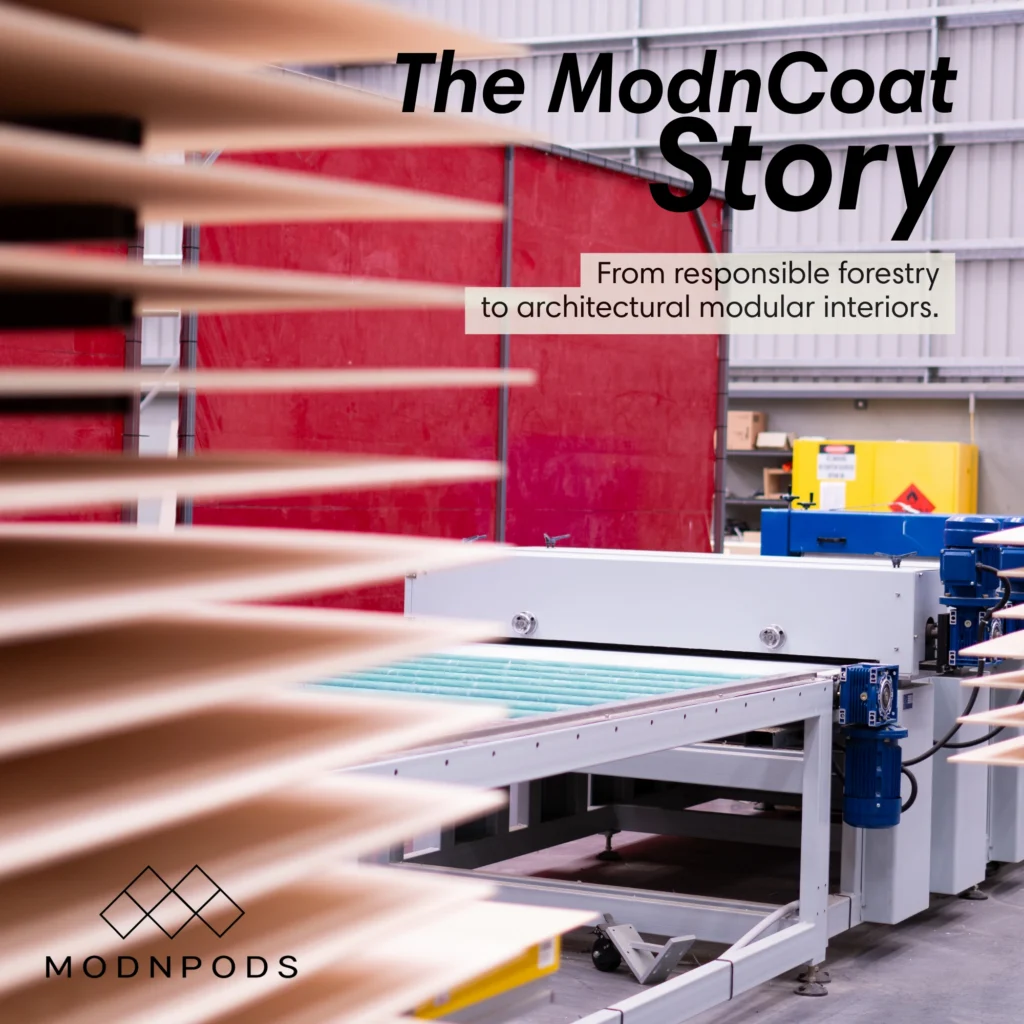
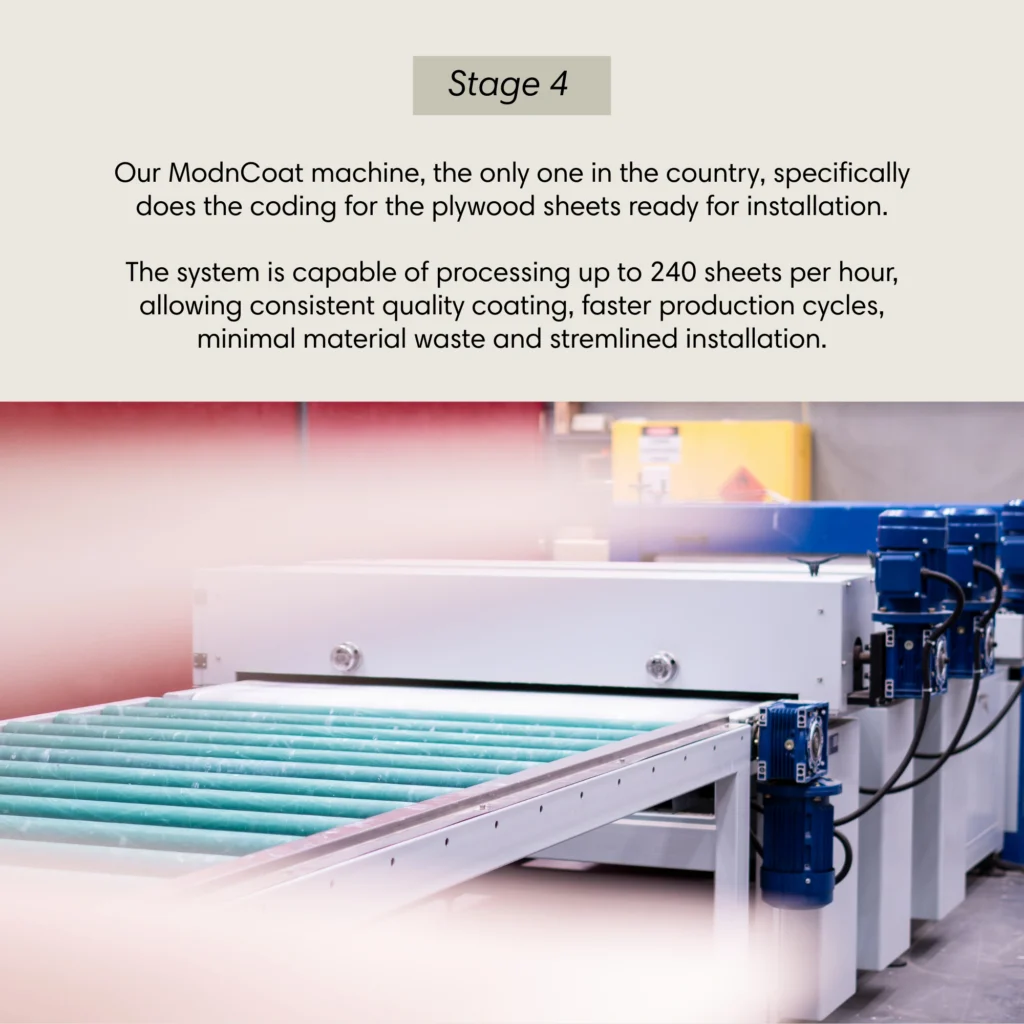
One of the core innovations inside our manufacturing process is the ModnCoat machine, a purpose-built automated system developed specifically for coating interior plywood wall linings.
The system is capable of processing up to 240 sheets per hour, allowing consistent finishing across large production volumes while eliminating the need for traditional interior painting.
This approach delivers several advantages:
• consistent coating quality
• faster production cycles
• reduced site finishing work
• minimal material waste
• streamlined installation within modular assemblies
By integrating finishing directly into the manufacturing process, ModnCoat supports lean production principles while improving final product consistency.
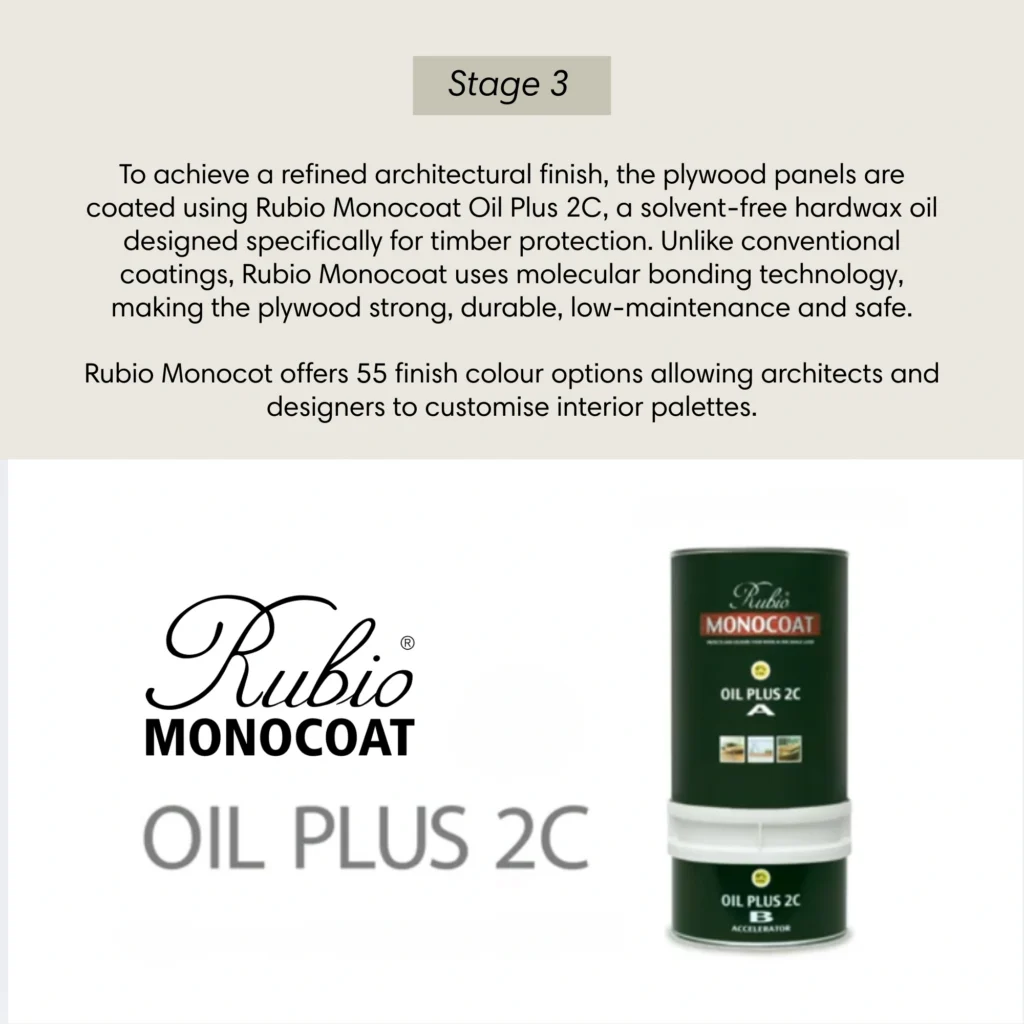
To achieve a refined architectural finish, the plywood panels are coated using Rubio Monocoat Oil Plus 2C, a solvent-free hardwax oil designed specifically for timber protection.
Unlike conventional coatings, Rubio Monocoat uses molecular bonding technology that forms a strong bond with the lignin and cellulose within the timber surface.
This technology offers several advantages:
• 0% VOC content
• Red List Free certification
• durable single-layer application
• natural timber appearance
• water and heat resistance
With more than 55 colour options available, the finish allows architects and designers to customise interior palettes while maintaining consistent quality across projects.
The result is a durable, low-maintenance interior surface with a natural timber aesthetic and healthier indoor air quality.
Plywood plays an important structural role in modular buildings.
Unlike plasterboard, plywood contributes to the structural behaviour of wall assemblies, providing diaphragm strength that improves overall rigidity during transportation and installation.
This is particularly important for modular buildings that are manufactured off-site and transported to their final location.
Benefits include:
• Improved structural stability during transport
• Resistance to cracking and impact
• Faster installation
• Architectural interior finish
• Reduced site finishing work
For modular construction, plywood is both a structural and aesthetic material.
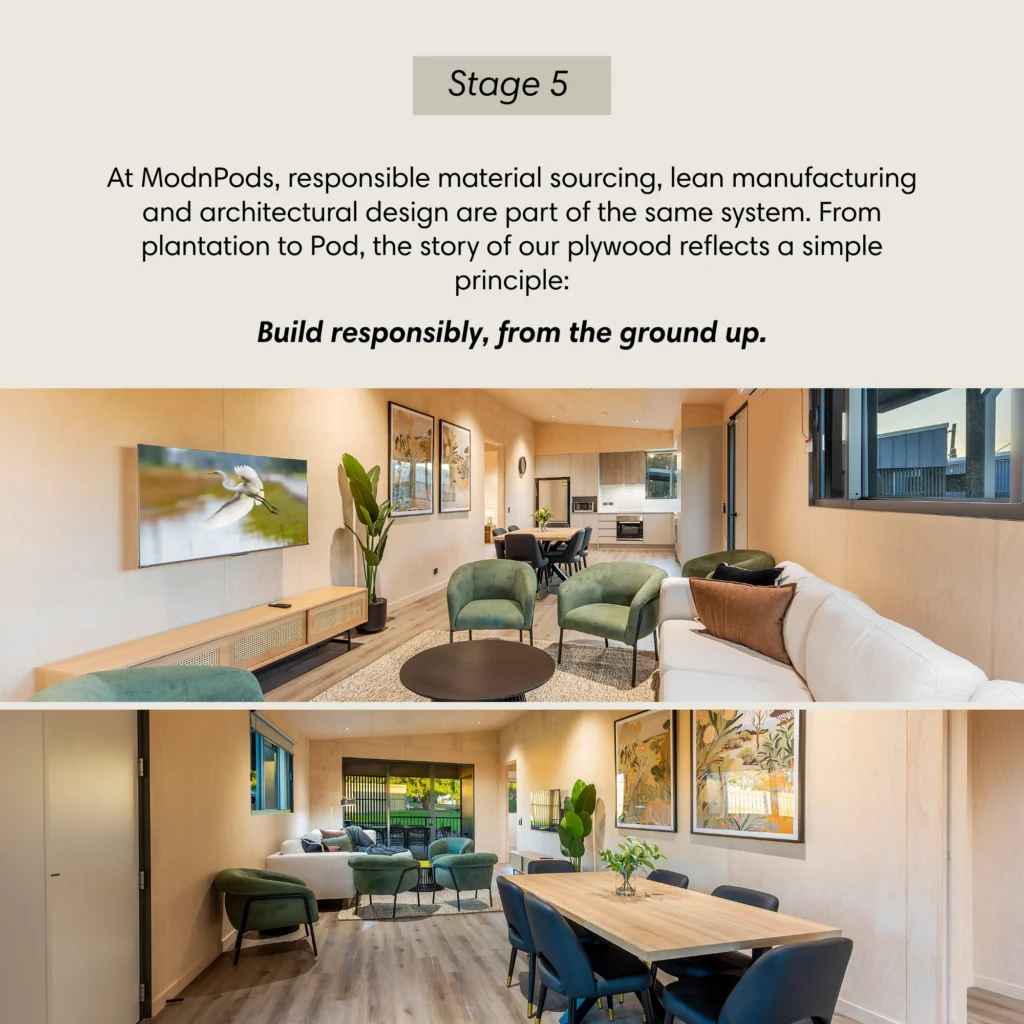
At ModnPods, responsible material sourcing, lean manufacturing and architectural design are not separate ideas — they are part of the same system.
From plantation to pod, the story of our plywood reflects a simple principle:
Build responsibly, from the ground up.
Excited about our ModnCoat machine? Check more information here
We are thrilled to share that McNab has announced a significant investment in ModnPods, marking a strategic partnership designed to accelerate residential construction and help address the growing demand for scalable modular housing solutions across South East Queensland.
McNab joins QIC, the Arc31 family office of Cathie Reid AM and Stuart Giles, alongside ModnPods founder John Christie and the broader ModnPods leadership team as investors in the business. ModnPods will continue to manufacture its established range of modular homes including single storey dwellings, duplexes and terrace housing, which remain a core part of the company’s production pipeline.
McNab Chief Executive Officer Kunjan Ganatra said the move aligned with McNab’s long-term housing strategy, providing deeper operational collaboration rather than simply taking a passive financial stake.
“Independent data confirms Australia’s housing undersupply is structural rather than cyclical, with systemic supply constraints unlikely to ease without productivity reform,” Mr Ganatra said.
“Labour shortages and cost volatility will continue to challenge traditional construction delivery models. At McNab, when we see sustained systemic pressure in the market, we respond with strategy and investment, and this partnership is a clear example of that”.
“This collaboration gives McNab direct access to a modular manufacturing platform capable of delivering the existing ModnPods product range of single storey dwellings, duplexes, terraces and low-rise housing, while also supporting the development of new medium-rise modular solutions across social and affordable housing, build-to-rent and residential projects”.
“Modular construction enables us to deliver these homes faster and with consistent quality, while expanding the types of projects we can support. Importantly, this sits alongside our traditional construction model. Modular construction provides an additional delivery pathway, allowing us to respond to different project requirements while continuing to build through conventional methods. The two approaches are complementary and together expand our ability to deliver housing at scale.”
Mr Ganatra said over the past two years McNab and ModnPods had invested millions in modular design development, global research and Queensland compliance frameworks, overcoming both the design and regulatory barriers that have historically limited modular construction, particularly in the medium-rise space.
“Together McNab and ModnPods have co-developed a proprietary medium-rise modular system and, by investing in ModnPods, we are now poised to industrialise housing delivery in Queensland while creating local jobs and unlocking faster, more certain project outcomes.”
ModnPods Chairman Stuart Giles welcomed the new partnership with McNab amid strong market demand for faster, more certain delivery models, particularly across social and affordable housing.
“We believe the ModnWay is up,” Mr Giles said.
“That philosophy runs through everything we do, whether that’s upskilling our team members and supporting their career development, uplifting the accommodation experience for our customers, or continuing to grow the scale of projects modular construction can deliver.
“ModnPods has built its reputation delivering high-quality modular homes including single storey dwellings, duplexes, terraces and low-rise developments, and those markets remain incredibly important to our business.
“This partnership with McNab allows us to continue growing those core areas while also developing the capability to deliver larger projects over time. It’s incredible that modular construction now allows us to provide housing at scale, including the potential to use land more efficiently and deliver housing solutions for more of the most vulnerable in our community, while maintaining the quality and certainty that governments, developers and communities expect.”
“Having McNab come on board brings significant operational capability, a wealth of delivery experience and valuable industry relationships. Combined with our established manufacturing facility, technical expertise and existing product range, this positions us to expand in response to the growing demand for modular construction.”
The partnership will manufacture modules locally on the Gold Coast, supporting regional employment and enabling a more diverse workforce through controlled, factory-based environments.
Factory-based construction also provides workers with greater certainty, allowing them to work from a single location with predictable hours. This creates opportunities for a more diverse workforce and enables people to better balance work and family commitments.
QIC Private Equity Head of Asia Pacific Crystal Russell said the partnership reflects growing conviction in modular construction as a scalable solution to strengthen Queensland’s housing supply.
“QIC has a clear mandate to invest in innovative local businesses that can lift productivity and deliver meaningful impact for Queenslanders,” Ms Russell said.
“There is no greater economic and social impact than delivering more housing, and vertical modular solutions are proving increasingly important to addressing structural supply challenges. Partnering with an established national contractor of McNab’s calibre provides ModnPods with the operational might to elevate their product offering and scale to a multi-storey model.”
The investment follows significant momentum for ModnPods in recent months, including a major contract win to create 29 affordable modular homes across North Stradbroke Island for the North Stradbroke Island Aboriginal and Islanders Housing Co-Operative.
Mr Giles said ModnPods continues to work with developers, builders and government partners across a wide range of housing projects and sees significant opportunity to support the delivery of new social and affordable housing across SEQ.
“This investment reinforces our long-term strategy to modernise construction, drive productivity reform and ultimately deliver homes faster for Queenslanders,” Mr Giles said.
To learn more about McNab visit www.mcnab.net.au. For information about ModnPods explore our website www.modnpods.com.au. For more information about QIC visit www.qic.com.
High resolution photos can be found here
ABOUT MCNAB
McNab is one of Australia’s largest and most trusted privately-owned construction and property groups, generating around $1 billion annually. With long-term industry relationships and a vertically integrated model that includes award-winning construction, property developments, building revitalisation, building materials, construction hire, and skilled trades and labour, McNab is uniquely positioned to deliver certainty and quality in an ever-changing environment.
ABOUT MODNPODS
ModnPods is an Australian modular manufacturing company delivering architecturally designed accommodation solutions through advanced modern methods of construction, helping address Australia’s growing demand for faster and smarter housing delivery.
ABOUT QIC
QIC is a trusted Australian investment manager and sovereign investor, delivering with discipline across a global portfolio of alternative and liquid assets. It manages more than A$137 billion on behalf of around 125 institutional and government clients, providing specialist expertise across infrastructure, real estate, private equity, private debt and fixed income and multi-asset solutions. Established in 1991 to manage the long-term investments of the Queensland Government, QIC has grown from a single-client mandate into one of Australia’s largest institutional investment managers, grounded in its sovereign heritage and guided by a global perspective.
At ModnPods, every material is selected for performance within a controlled manufacturing environment. As a leader in modular construction in Australia, we require materials that integrate seamlessly with off-site production, lightweight steel systems and lean manufacturing.
That’s why COLORBOND® steel is a core component of our modular roofing and modular wall cladding systems.
60 years and counting, COLORBOND® steel remains one of the most trusted materials in residential and commercial construction.
Many of our modular buildings are delivered in coastal, regional and remote environments where exposure to UV, wind and salt air is significant.
COLORBOND® steel for modular roofing systems and external wall cladding provides:
For ModnPods, material reliability is fundamental in prefabricated construction and consistency across multiple modules ensures predictable outcomes in cost, quality and program which keeps our Lean Manufacturing commitment on track.
Within our modular construction system, COLORBOND® steel is typically used for:
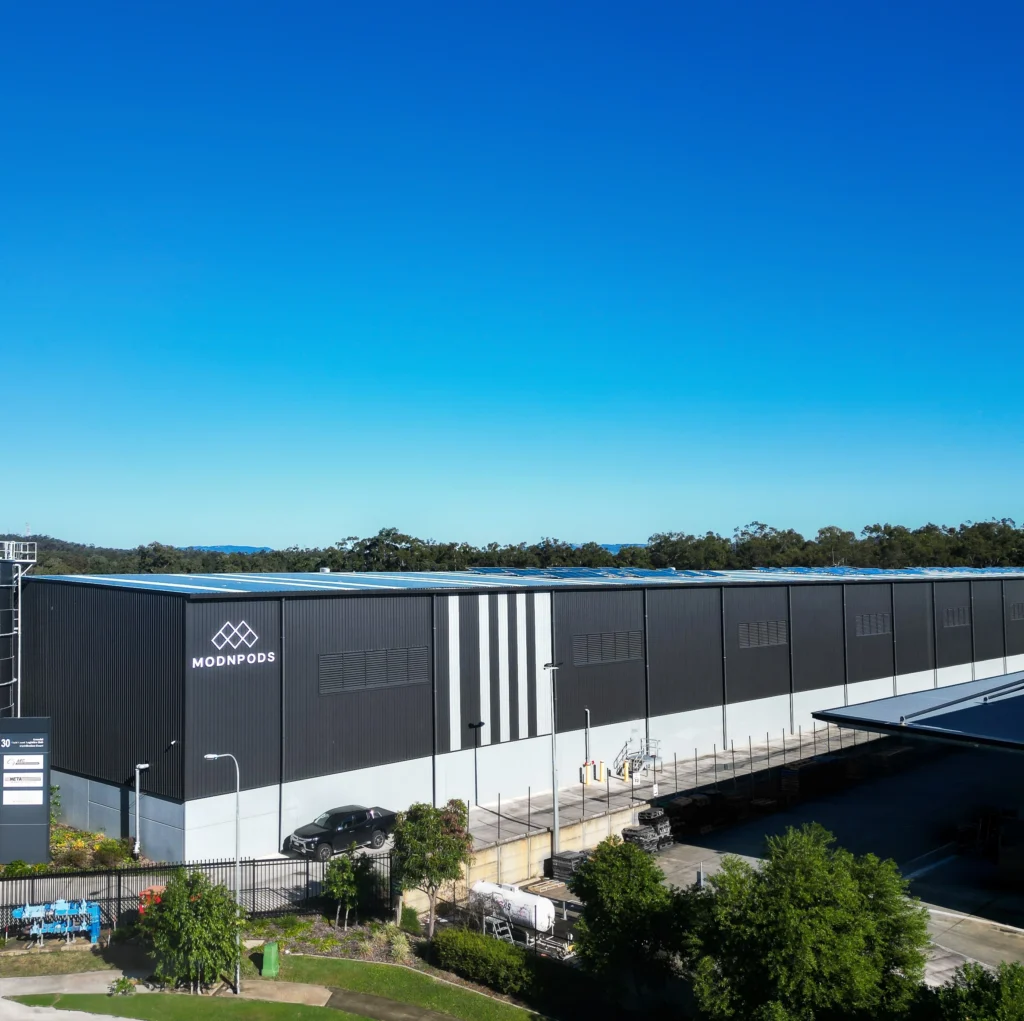
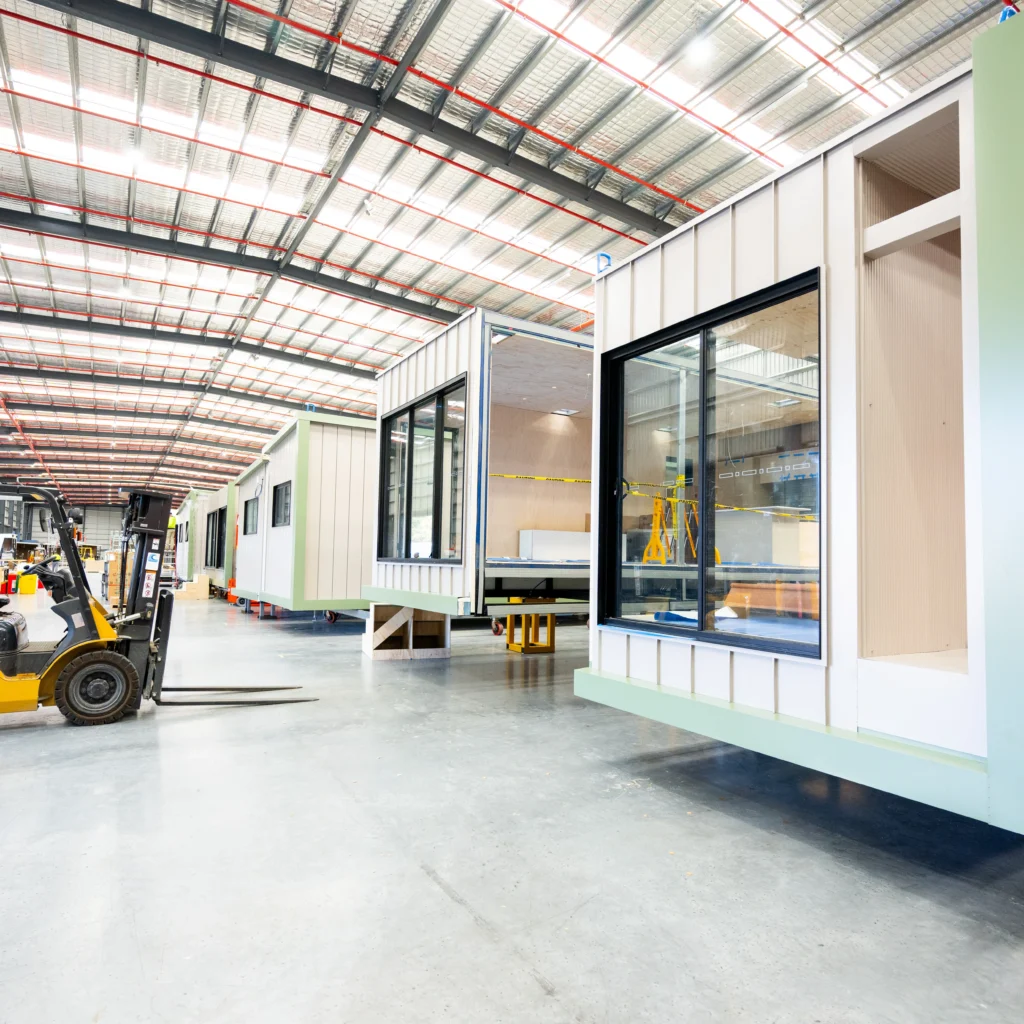
Because up to 90% of construction is completed off-site in our 6,300m² Gold Coast facility, pre-finished steel cladding plays a critical role in our Modern Methods of Construction (MMC) methodology.
Factory-installed modular wall cladding systems allow for:
This supports scalable modular building delivery across staff accommodation, community housing and tourism projects.
As we all know, modular architecture requires materials that balance performance with precision detailing.
COLORBOND® steel supports clean rooflines, articulated façades and contemporary modular forms. Its colour range — inspired by Australian landscapes — allows projects to respond to their context while maintaining repeatable manufacturing standards.
For architects, this enables façade flexibility within a modular framework.
For builders, it ensures compatibility with lightweight steel framing and prefabricated wall assemblies.
At ModnPods, supplier partnerships are aligned with durability, build-ability and long-term value. Today we celebrate COLORBOND® 60 years anniversary with great satisfaction.
Using COLORBOND® steel across our modular roofing and wall cladding systems reinforces our commitment to:
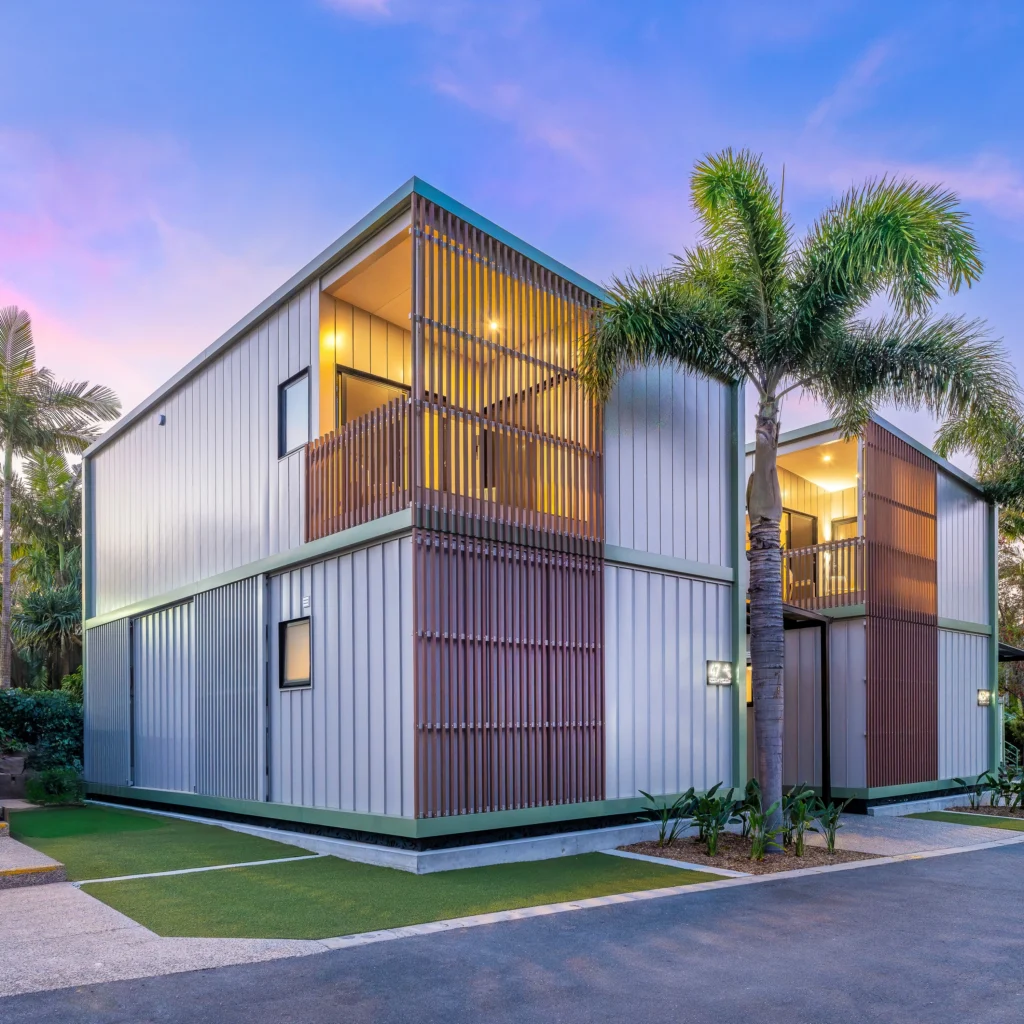
Every roofline and façade we deliver reflects that shared standard. Check one of our most recent Low Rise projects, Ashmore Palms featuring COLORBOND® materials.
Learn more about COLORBOND® steel and its performance in Australian conditions at https://colorbond.com
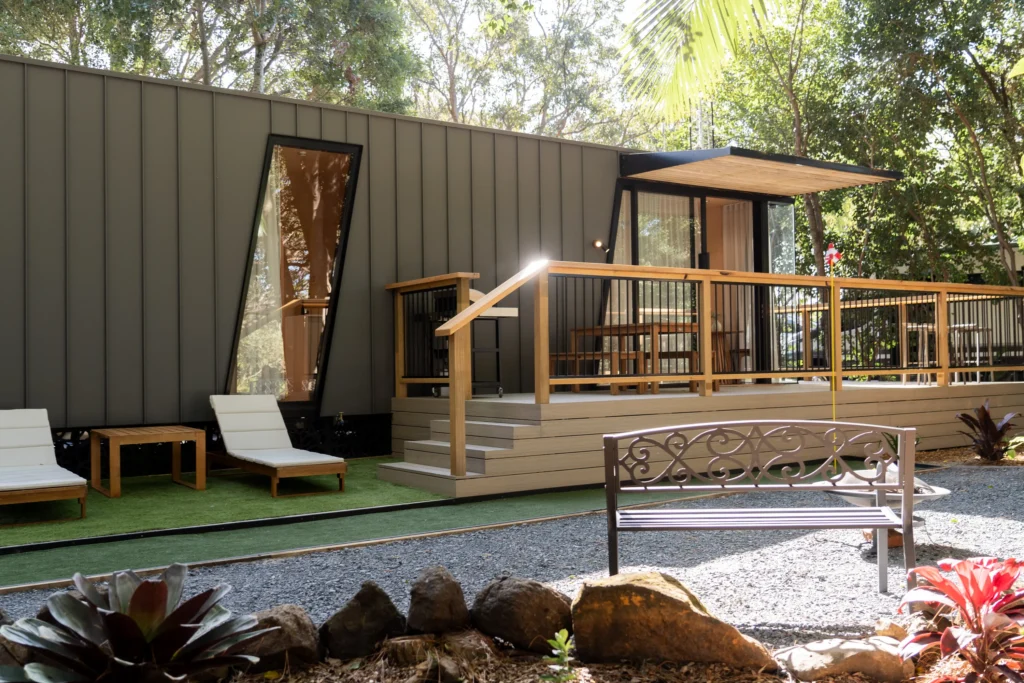
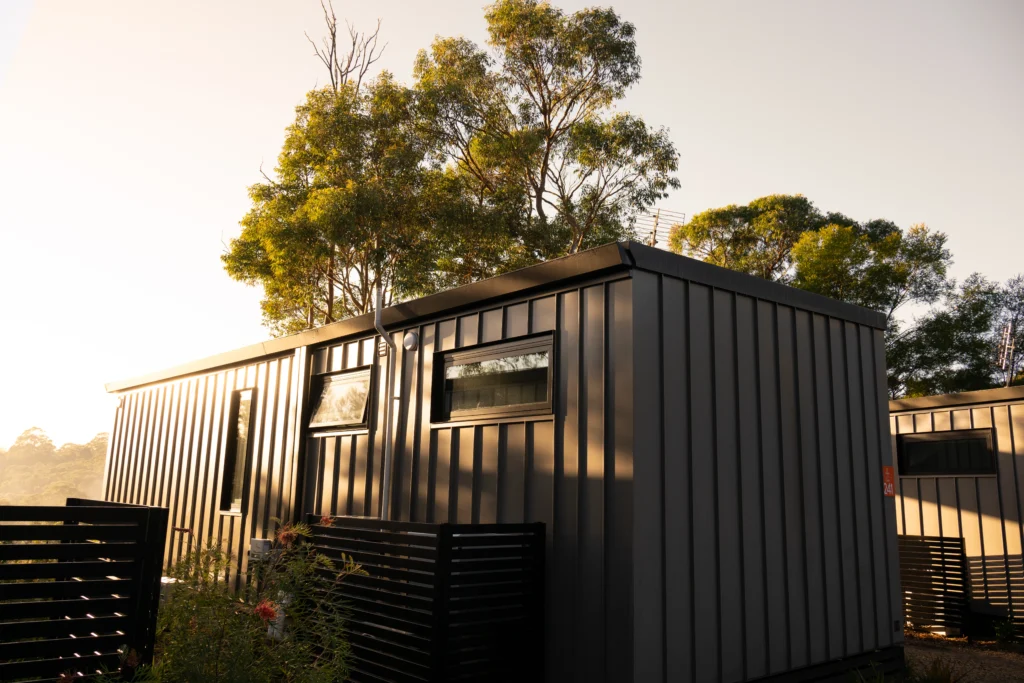
Industry frameworks are often talked about, but not always clearly defined. MMC is one of those terms. In this article, we’ll explore what Modern Methods of Construction mean to ModnPods — and how we apply it across design, manufacturing and installation. Before we do, it’s worth clarifying what MMC actually refers to. Modern Methods of Construction (MMC) describes a suite of construction approaches that move critical building activities away from traditional site-based delivery and into controlled, repeatable environments.
At ModnPods, MMC is the foundation of how we design, manufacture, transport and install buildings across Australia. Our approach combines off-site manufacturing, digital design coordination, lean production systems and precision installation to deliver buildings that are faster to deploy, cost-predictable and built for long-term performance.
MMC is often misunderstood as “temporary”, “transportable” or “lightweight”. In reality, MMC encompasses:
Volumetric modular construction
Panelised and component-based prefabrication
Hybrid construction models combining off-site and on-site works
Digitally led design-for-manufacture-and-assembly (DfMA)
ModnPods applies MMC through fully enclosed volumetric modular buildings, manufactured under controlled factory conditions in our 6,300m² Gold Coast facility, then installed on site using engineered foundations and precision cranage.
MMC starts at concept stage. Our in-house design and engineering teams work through a staged, gated design process that embeds:
Site constraints and transport limits
Modular repeatability and scalability
Safety in Design (SiD) from concept to IFC
NCC, DDA and performance compliance verification at every stage
This ensures designs are not just compliant — they are buildable, repeatable and installation-ready before manufacturing begins.
"At ModnPods, Design is resolved before construction begins — not during it".
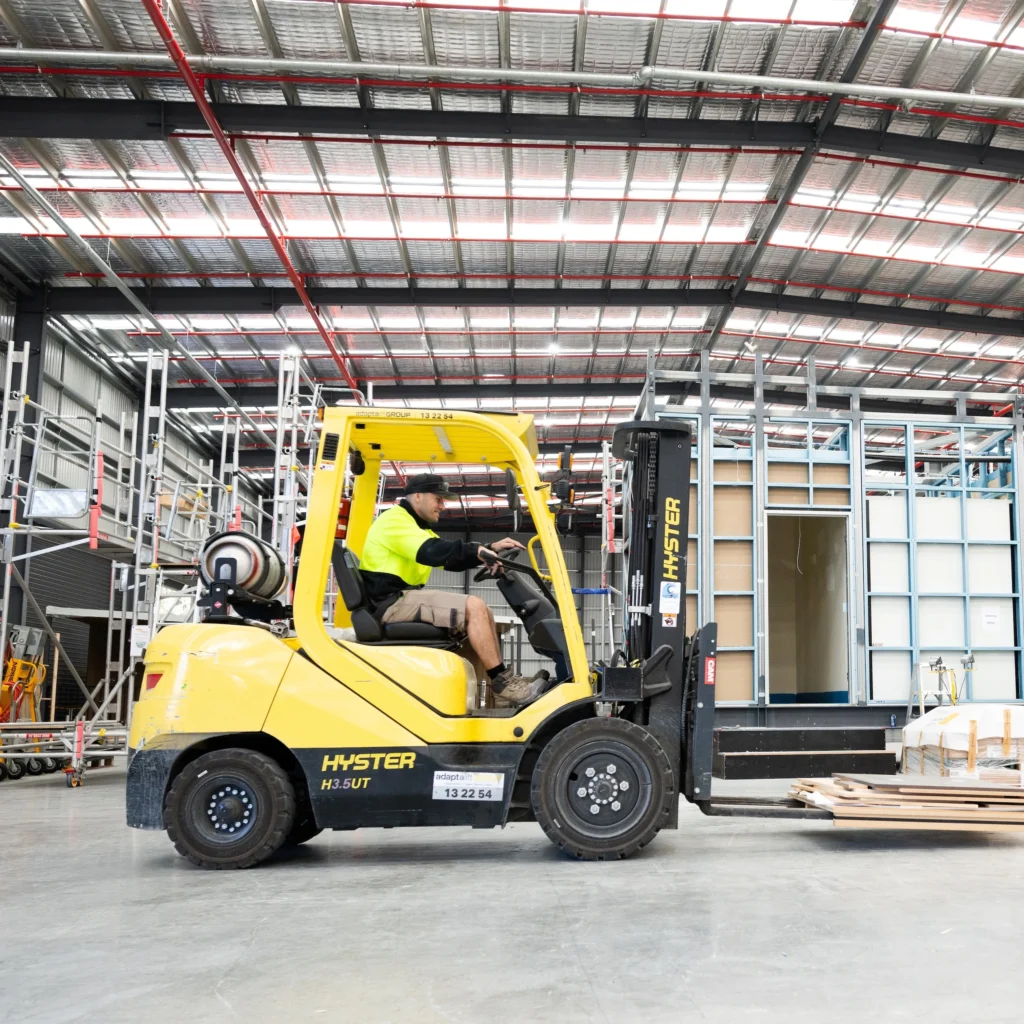
Every ModnPods build is manufactured in our 6,300m² Gold Coast facility using lean manufacturing principles and digitally driven production systems. Factory conditions remove weather risk, reduce rework, and enable consistent quality control that traditional site-based builds struggle to achieve.
This includes:
Heavy-gauge steel chassis engineered for transport, stacking and long-term durability
Light-gauge steel framing and integrated wall and roof systems
Automated roll-forming directly from BIM models
Fully completed internal fit-outs prior to delivery
MMC on Site: Faster, quieter, more predictable
MMC does not eliminate site works — it reduces complexity; that’s the beauty and grade of modular solutions.
At ModnPods, site works run in parallel with manufacturing and typically include:
Screw pile foundations (preferred where soil conditions allow)
Pre-installed service interfaces
Engineered cranage and placement
Rapid “plug-and-play” connections
MMC supports sustainability through process control, not shortcuts. Our environmental approach includes:
Reduced material waste through factory optimisation
Durable, low-maintenance materials selected for long service life
Energy-efficient building envelopes
Reduced site disturbance and ground impact
Circular economy thinking embedded into materials and supply chains
Sustainability, for ModnPods, is about quality, longevity and performance over the full life of the building.
MMC is not a replacement for traditional construction — it is a collaborative evolution.
ModnPods regularly works with:
Builders delivering site works and services
Architects designing within modular frameworks
Government and institutional clients requiring certainty at scale
Hybrid models allow traditional construction expertise and off-site manufacturing to work together — improving certainty, reducing risk, and accelerating delivery without compromising design intent.
In summary, Modern Methods of Construction enable better outcomes when applied with discipline, experience and transparency. At ModnPods, MMC is proven, scalable, and embedded into how we deliver modular solutions in Australia.
To learn more about our Lean Manufacturing Advantage is, check our ModnWay here.

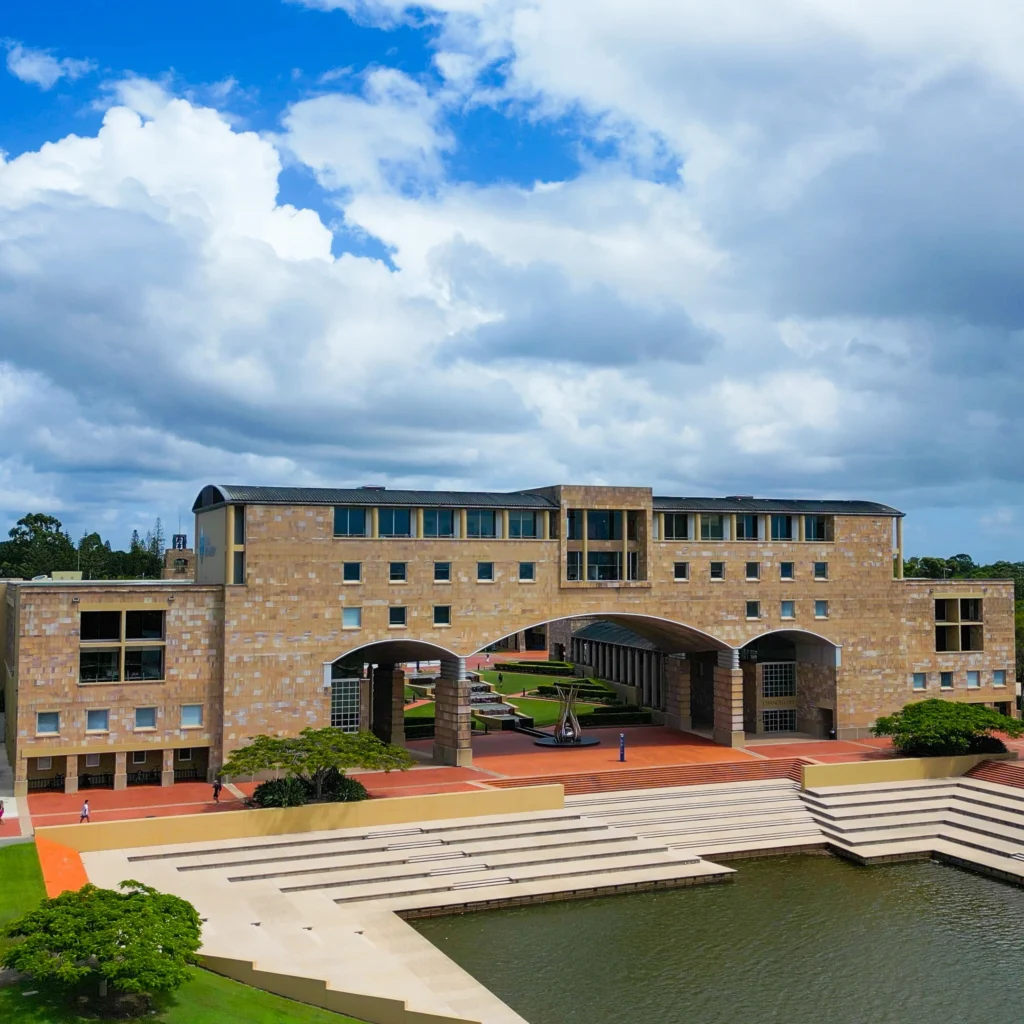
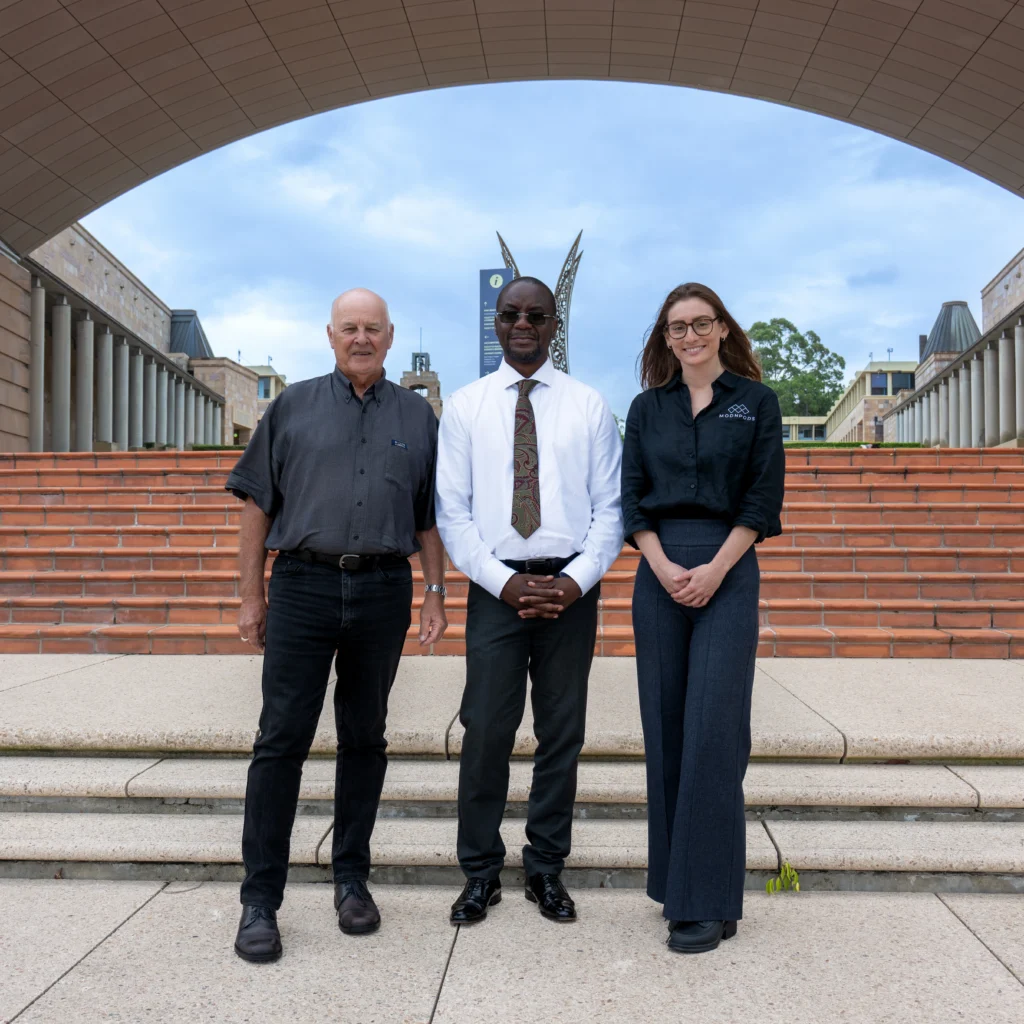
At ModnPods, we believe the future of construction is shaped by collaboration, shared knowledge, and real-world experience. That belief guided our recent partnership with Bond University, where we actively supported Master of Architecture students as they completed one of the most important milestones in their studies.
Our involvement went far beyond observation. It was about opening doors, sharing insights, and helping bridge the gap between academic learning and industry practice — particularly within the evolving world of modular manufacturing.
From the Factory Floor to the Panel Room
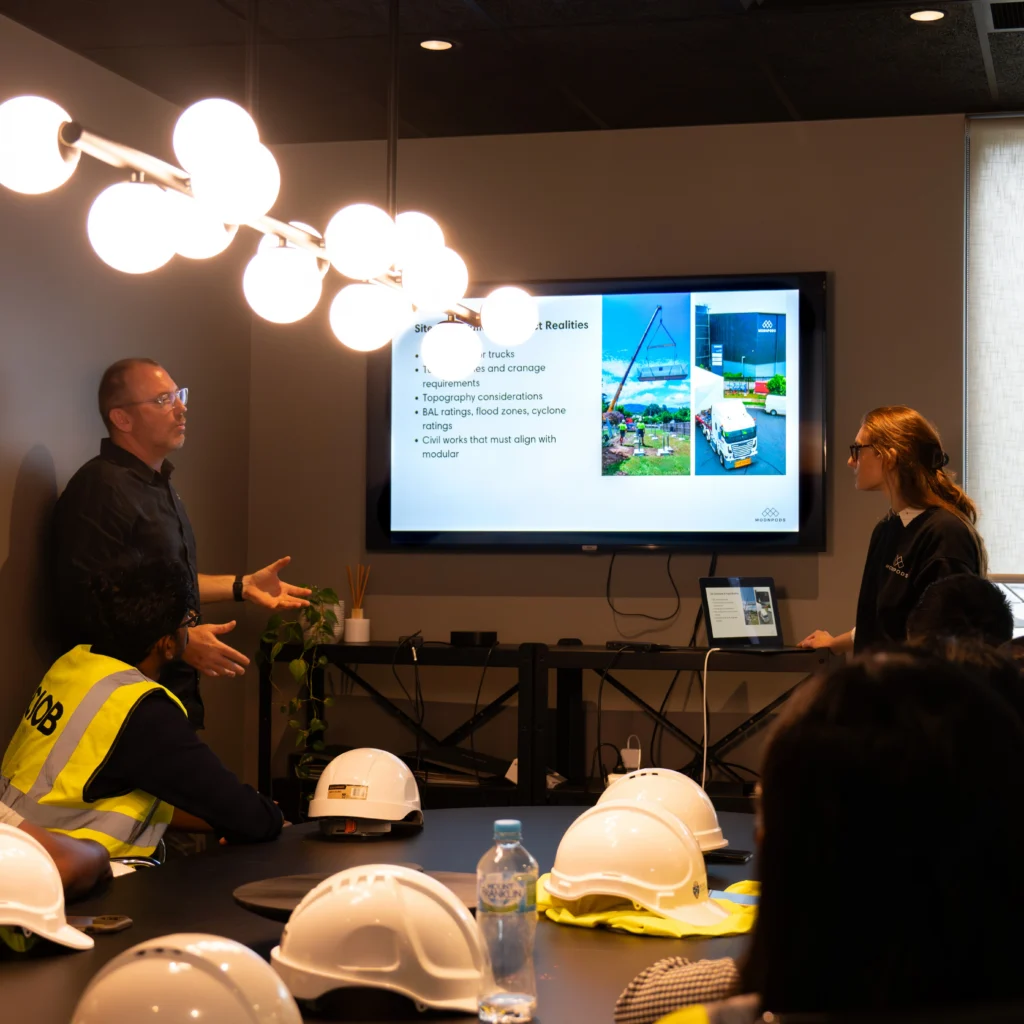
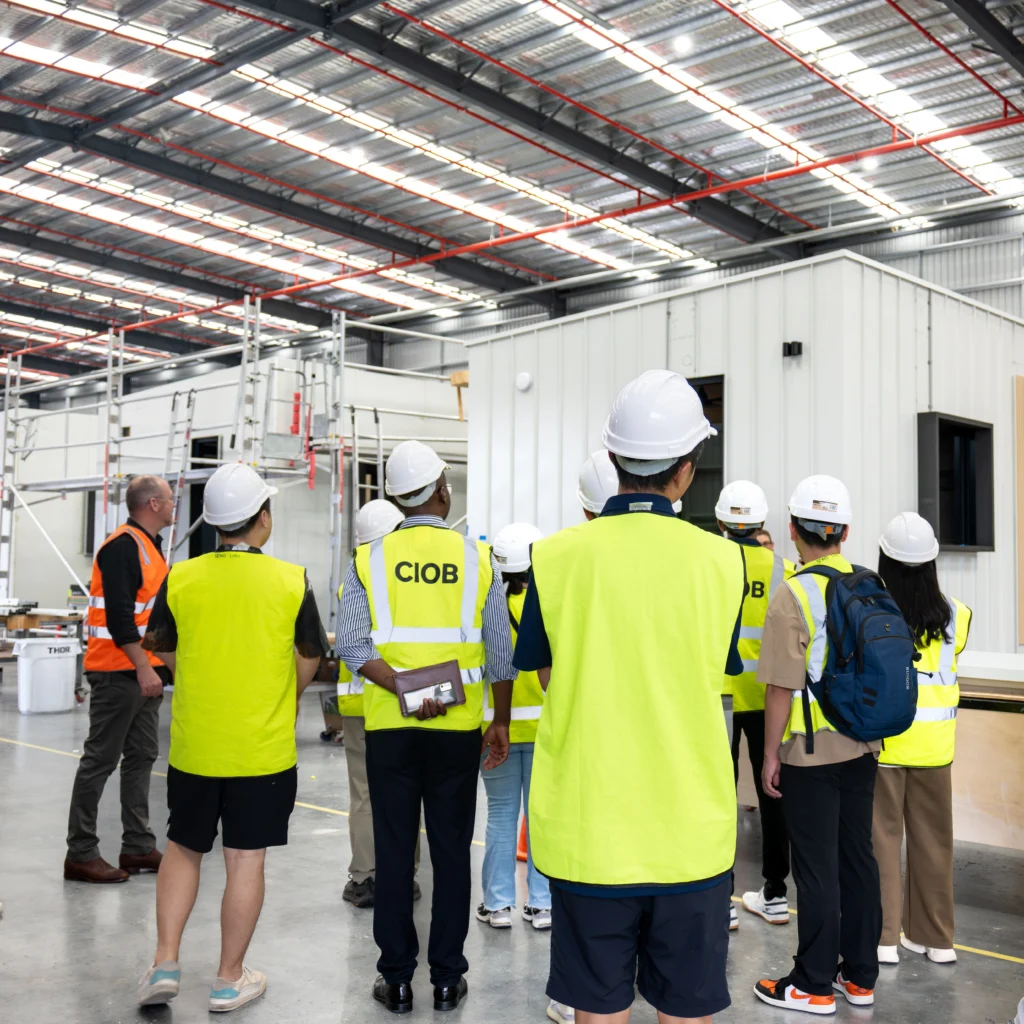
Earlier in the semester, we invited around 30 Master of Architecture students to our ModnPods HQ and manufacturing facility. They gained a behind-the-scenes look at how we design, manufacture, and deliver modular buildings from start to finish.
Our team walked students through every stage of our modular process — from early design thinking and standardisation to lean manufacturing, quality control, and on-site installation methodology. We shared real project examples, lessons learned, and the decision-making strategies that lead to successful modular outcomes.
More than anything, curiosity defined the day. The questions, conversations, and energy reinforced why these interactions matter: they spark understanding, challenge assumptions, and inspire new ways of thinking about design and delivery.
The session was led by our Founder and Director John Christie, Lead Designer Alba Berger, and GM Developments Guy Martin, each offering a different lens on what it takes to deliver high-quality modular outcomes at scale.
Closing the Loop: Industry in the Classroom
That factory visit set the foundation for the next step — participating in the final student presentations as part of Bond University’s industry panel.
Our Lead Designer Alba Berger joined David Manase – Academic & Construction Industry Practitioner and Steve MacRae from Steve MacRae Development Services to review student proposals exploring modular accommodation within an active university campus environment.
The presentations demonstrated thoughtful consideration of design quality, delivery methodology, and the role of off-site pod manufacture supported by on-site installation. It was encouraging to see how students translated both academic theory and real-world exposure into considered, practical responses.
Being part of this process reinforced the value of industry engagement — not just in assessing outcomes, but in helping shape how future designers think about buildability, efficiency, and long-term impact.
A Partnership Built on Shared Values
This connection with Bond University has been building over time. Four months ago, conversations began around how we could work more closely together — exploring ways to deepen collaboration between education and industry.
That relationship is personal as well as professional. Our Founder, John Christie, is a Bond University alumnus, and our Managing Director Stuart Giles holds the role of Bond Transformer Founder in Residence. These shared roots create a strong foundation for ongoing partnership, mentorship, and innovation.
Looking Ahead
We see supporting emerging designers and thinkers as part of how we invest in the future of modular construction. By hosting students, sharing our process, and contributing to their learning journey, we’re not just shaping the next generation — we’re shaping how they think about build-ability, efficiency, and long-term impact.


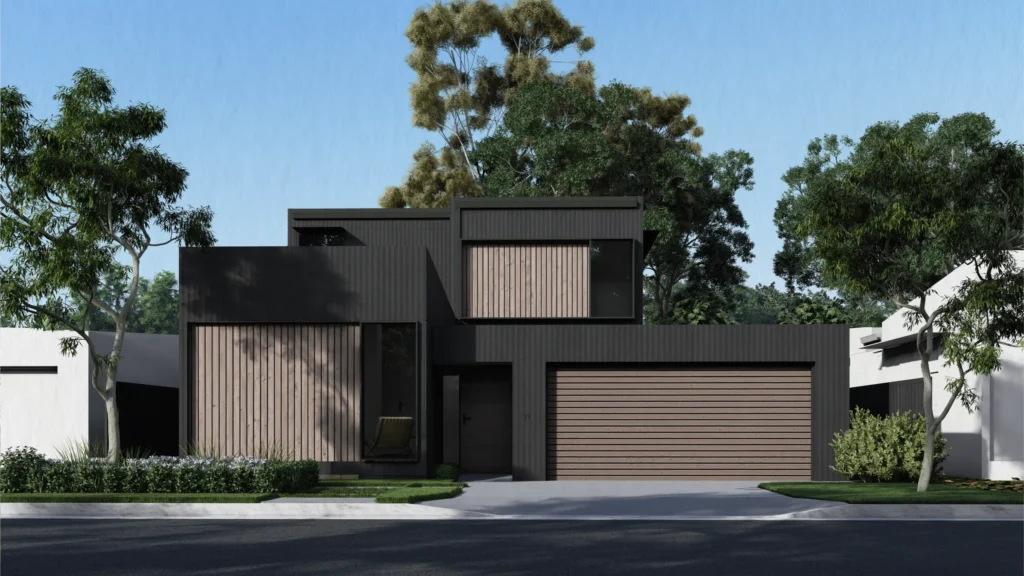
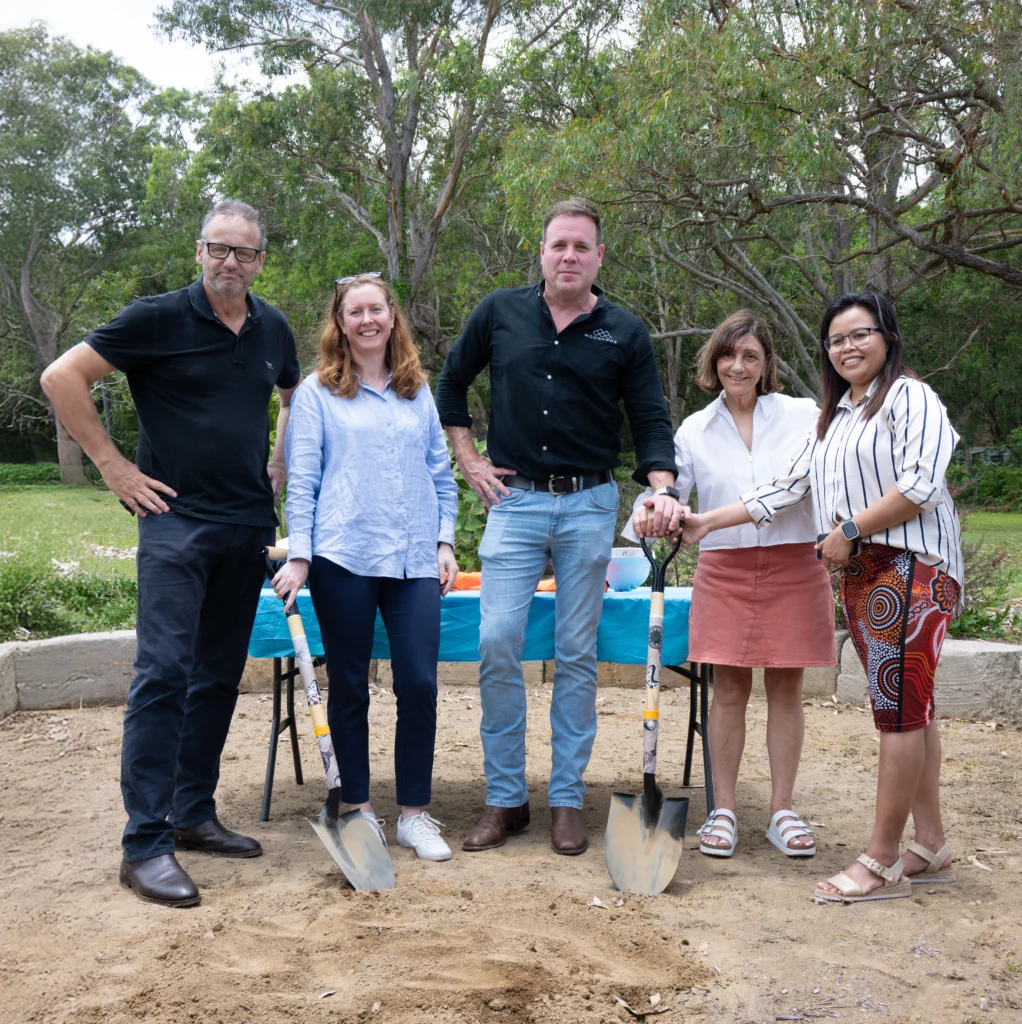
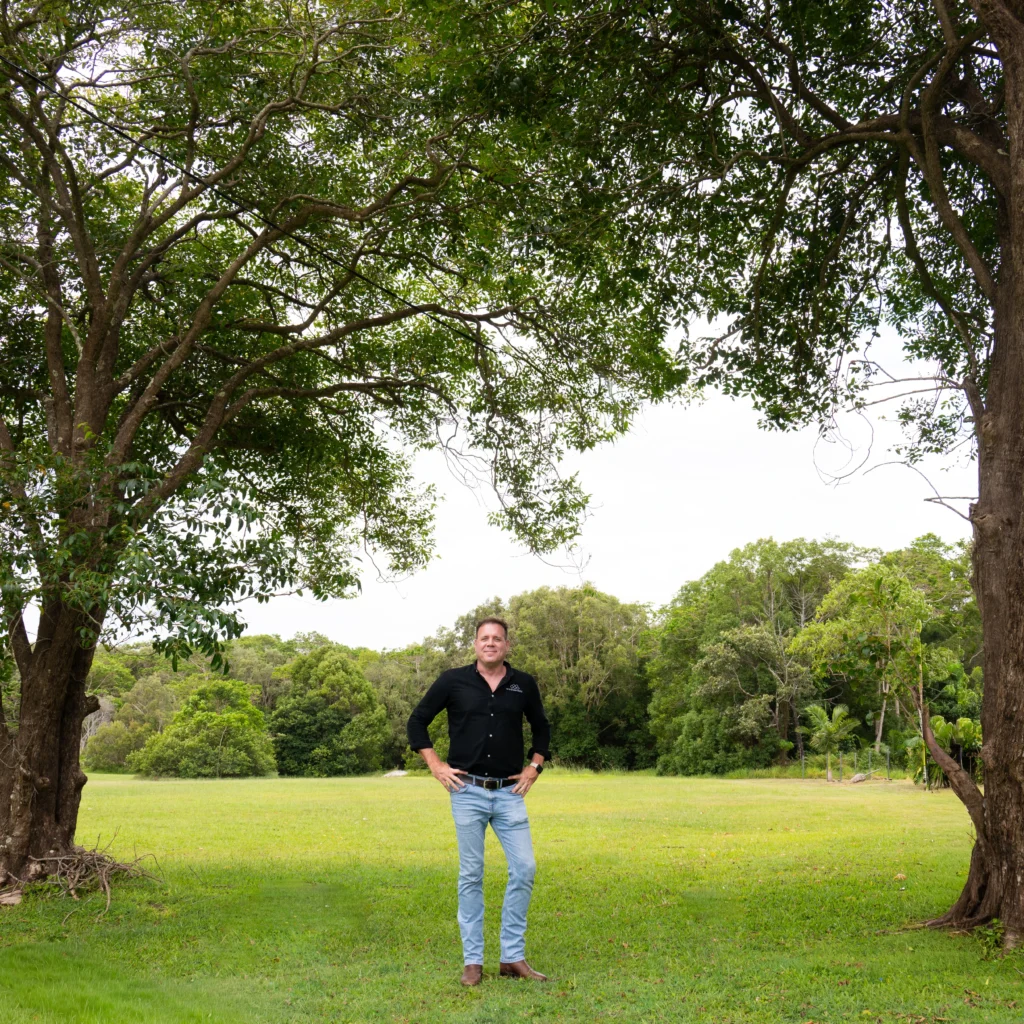
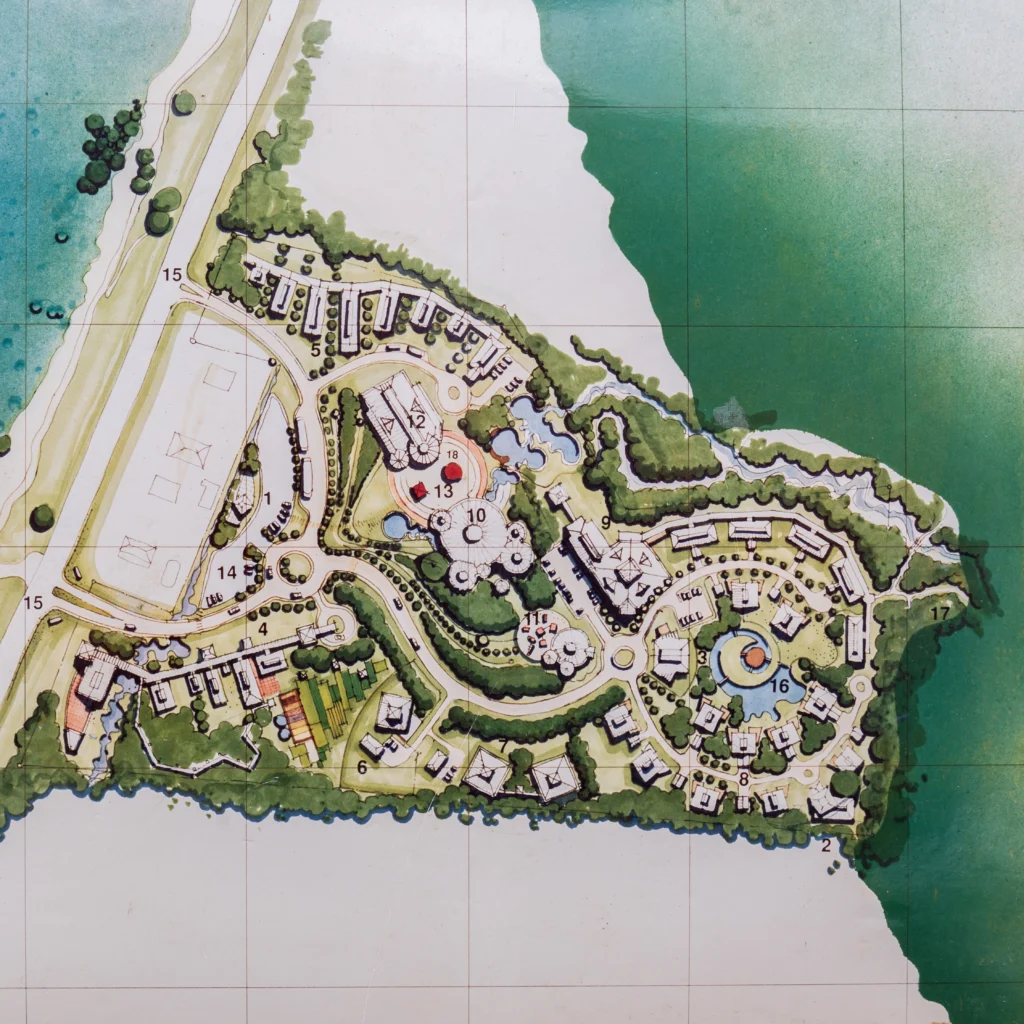
ModnPods is proud to share our first confirmed project of 2026: the delivery of 29 new homes for the North Stradbroke Island Aboriginal & Islanders Housing Cooperative, delivered in collaboration with the Queensland Department of Housing and Public Works and Kaunitz Yeung Architecture.
Located on North Stradbroke Island, this project represents more than the delivery of housing — it reflects a shared commitment to community, trust, and thoughtful design, supported by Modern Methods of Construction (MMC).
This project has been made possible through the support of the Queensland Government and the North Stradbroke Island community, with all partners aligned around a clear goal: delivering high-quality, well-designed homes through a smarter, more efficient construction approach.
By using MMC and off-site manufacturing, ModnPods is able to focus on:
Consistency and quality in design and construction
Reduced on-site disruption
Greater certainty in delivery outcomes
This approach supports the delivery of homes that are built with care, intention, and long-term performance in mind.
From the outset, the North Stradbroke Island community welcomed the ModnPods team with openness and warmth. That trust is something we hold with deep respect.
As manufacturing commences, we recognise the responsibility that comes with delivering homes for community — and the importance of listening, collaborating, and working in a way that honours place and people.
At ModnPods, we believe that how housing is delivered matters just as much as what is delivered. Our work is guided by strong corporate commitments that place people and planet at the centre of every project. From lean manufacturing processes and quality assurance through to ethical collaboration and local employment, each project reflects our commitment to building better — not just faster.
This North Stradbroke Island project is a clear example of what can be achieved when government, community, architects, and manufacturers work together with shared intent.
As our first project of 2026, this development marks an important milestone for the ModnPods team and reinforces the role modular construction can play in delivering meaningful housing outcomes across Queensland and Australia.
We are proud to be part of this journey and grateful for the trust placed in us by all project partners.
At ModnPods, modular construction is not just about efficiency — it’s about responsibility.
Our operations are guided by strong corporate commitments that place people and planet at the centre of how we do business. From lean manufacturing principles and ethical supply chains to local job creation and community impact, every Pod we build reflects our belief that better housing outcomes require better ways of working collaboratively.
ModnPods is proud to:
Manufacture locally and support Australian supply chains.
Design with environmental responsibility in mind across the full lifecycle of our buildings.
Foster a culture of continuous improvement, safety, and respect for our people.
Work collaboratively with government, industry, and community partners.
These commitments shape represent not only who we are and what we build, but how we grow.
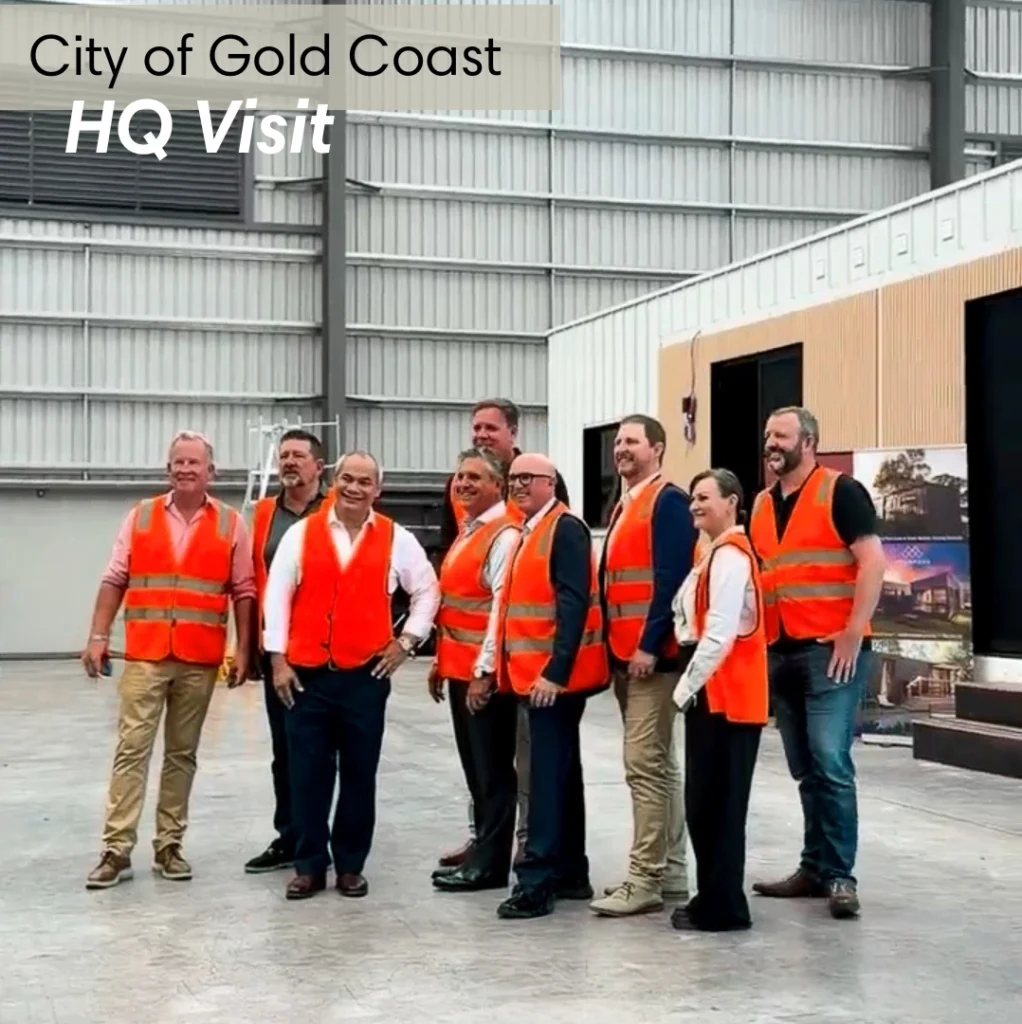
Mayor Tate’s visit this week reinforced something we strongly believe: the Gold Coast is a city that says yes to bold ideas — and modular construction is one of them. As housing demand increases, off-site manufacturing offers a proven and scalable solution. With plans to expand our operations even further, ModnPods is focused on delivering housing solutions that are practical, high-quality, with exquisite design in mind.
We’re proud of what we’re building on the Gold Coast — for the Gold Coast, and for communities across Australia.
Thank you City of Gold Coast and Invest Gold Coast for your continued support!
Let’s go.
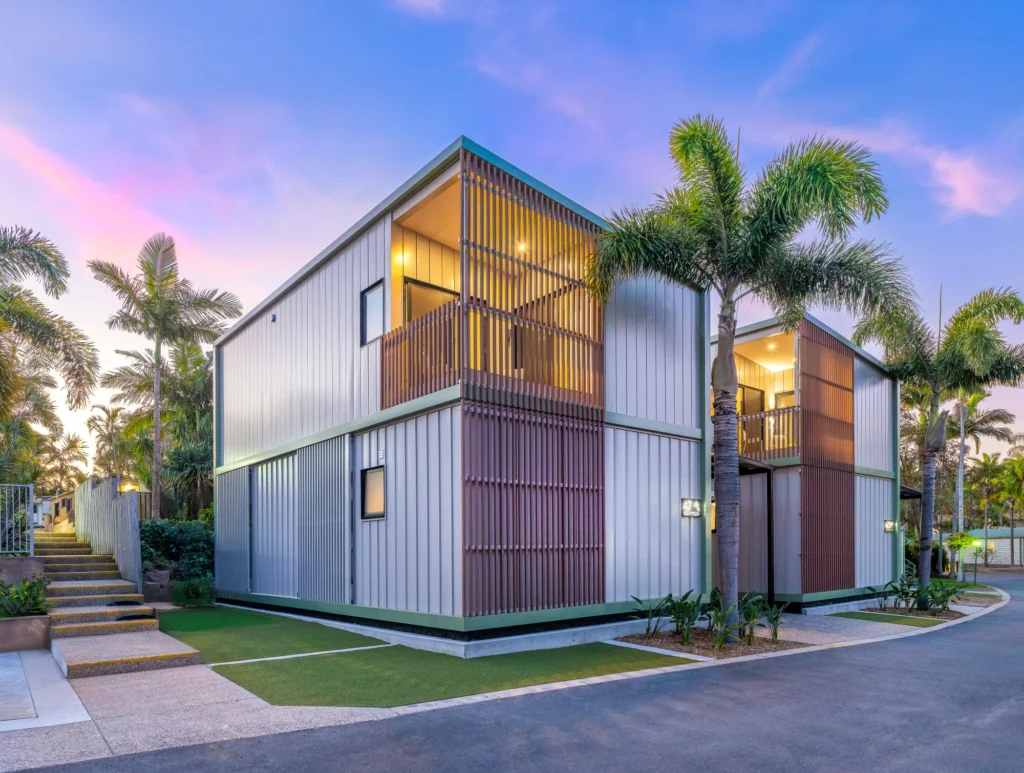
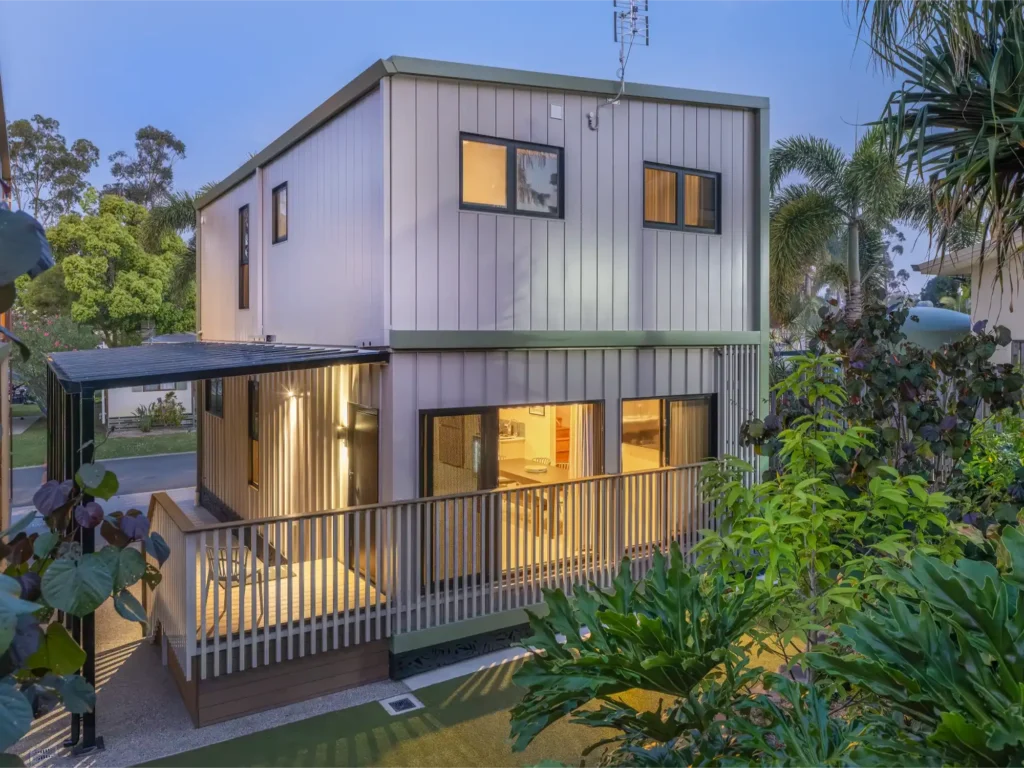
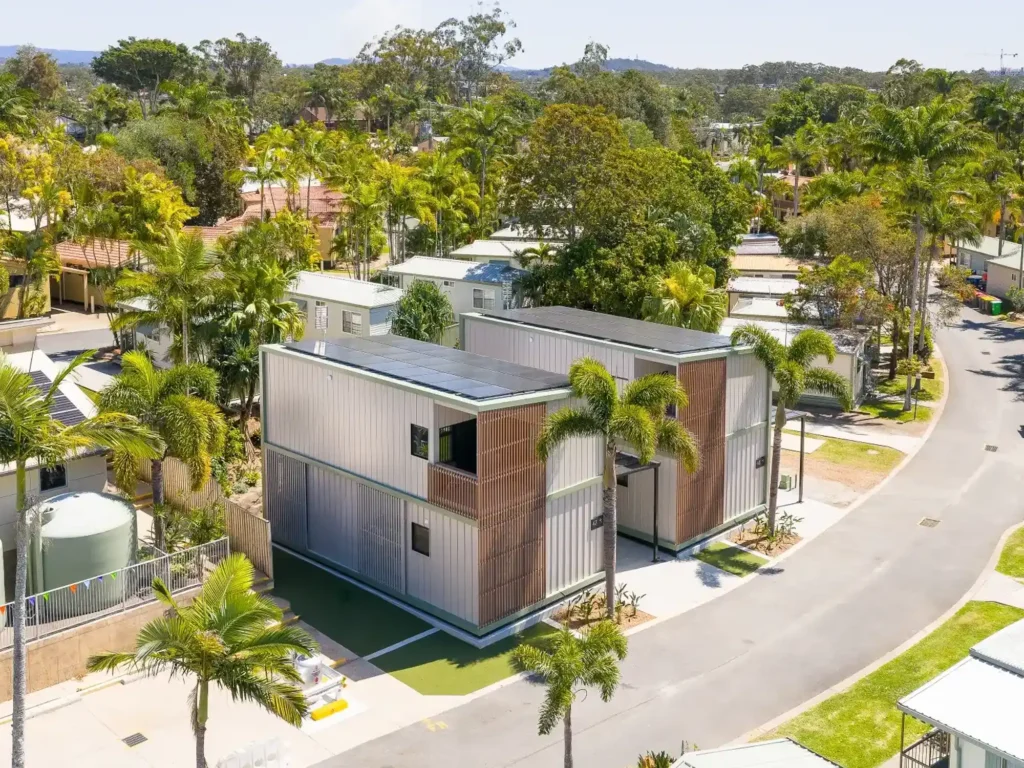
ModnPods has delivered its first two-storey modular accommodation project at Ashmore Palms Holiday Village on the Gold Coast. The project marks an important milestone for the company and demonstrates how modular manufacturing can support the evolving needs of the tourism sector.
Ashmore Palms Holiday Village is a well-known destination that continues to invest in high-quality accommodation for its guests. As a result, the project provided the perfect opportunity to introduce a new two-storey modular solution designed for holiday parks and tourism operators.
Traditionally, modular accommodation in holiday parks has been limited to single-storey buildings. However, growing demand for higher density accommodation is changing the way these spaces are designed.
ModnPods responded by developing a two-storey modular accommodation solution that maintains architectural quality while improving land efficiency. In addition, the design allows operators to increase accommodation capacity without expanding the overall site footprint.
This approach supports tourism operators who want to grow their offering while maintaining the character of their existing sites.
The project was manufactured at the ModnPods facility using the company’s advanced modular production systems.
Because the majority of construction occurs off-site, manufacturing can run in parallel with site preparation. As a result, overall project timeframes can be significantly reduced compared with traditional construction methods.
At the same time, the controlled factory environment ensures consistent quality and improved efficiency throughout the build process.
This project highlights the growing role of modular construction within the tourism and accommodation sectors.
More importantly, it demonstrates how modular buildings can support operators who need faster delivery, consistent quality, and well-designed accommodation for their guests.
As tourism demand continues to grow across Australia, modular manufacturing offers a scalable solution for the future of holiday park development.
The completion of this project represents an important step in the ongoing evolution of ModnPods’ modular solutions.
By delivering its first two-storey modular accommodation project, ModnPods continues to expand what is possible within modular construction. The result is a flexible building approach that supports modern tourism accommodation while maintaining architectural integrity and construction efficiency.
For more information about the project check all the details about this project in the Case Study section!
Select your desired option below to share a direct link to this page.
Your friends or family will thank you later.